


Poor communication during medical leave doesn't just frustrate employees; it creates real legal exposure. The U.S. Department of Labor confirmed 349 FMLA violations in FY 2024, a 4.5% increase from the prior year, with denial of leave accounting for 33% of all violations. For HR teams managing frontline workers across shifts, job sites, and multiple languages, the risk multiplies when critical notices can't reach employees through traditional channels. This guide walks you through eight practical steps to keep your leave communication compliant, consistent, and human.
TL;DR
- Poor leave communication is a growing compliance risk, with FMLA violations up 4.5% in FY 2024 and a single ADA noncompliance case costing an average of $500,000.
- Many employers follow two five-business-day deadlines after learning of an employee's potential need for leave, and missing either deadline can expose them to legal liability.
- Train managers to recognize leave triggers, protect medical confidentiality, and route all leave-related communications through HR.
- SMS-based tools such as Yourco help HR teams deliver leave notices, check-ins, and return-to-work updates to employees on any mobile device, with automatic translation and timestamped audit trails.
- Start return-to-work planning early and conduct individualized assessments rather than applying blanket "100% healed" policies.
Recognize the Compliance Risks Behind Poor Leave Communication
Most FMLA communication failures start with a supervisor who didn't know that a casual mention of "back pain" could trigger protected leave, or with an HR team that missed a five-business-day notice deadline because a worker was on a night shift.
Under federal guidelines, many employers follow two key five-business-day deadlines after learning of an employee's potential need for leave. Missing either deadline could limit the employer's ability to deny FMLA protections if the employee is harmed by the lack of notice. The financial consequences go beyond fines, as courts may order back pay, liquidated damages that could double the award, and attorneys' fees. The most common communication-related violations that lead to litigation include:
- Inadequate certification deficiency notices: Failing to provide specific written notice of certification problems with the required seven-day cure period
- Excessive or discouraging contact during leave: Communications that discourage leave usage can cross the line into FMLA interference, even without outright denial
- Demanding documentation beyond statutory guidelines: For example, recent DOL guidance clarified that certifications need not include travel time estimates
ESIS research found that single mismanaged ADA noncompliance cases cost an average of
For specific compliance guidance, consult with qualified legal professionals.
Acknowledge Requests and Deliver Required Notices on Time
The first hours after learning about a leave need set the tone for the entire process. A fast, clear response protects both the employee's rights and your compliance standing. These two steps cover the critical window between the initial request and formal designation.
Step 1: Send immediate acknowledgment with next steps
When an employee requests time off for a medical reason, even without using the word "FMLA," many employers train managers to notify HR immediately rather than determine eligibility themselves. This typically triggers HR's responsibility to deliver the required formal notice within the five-business-day deadline.
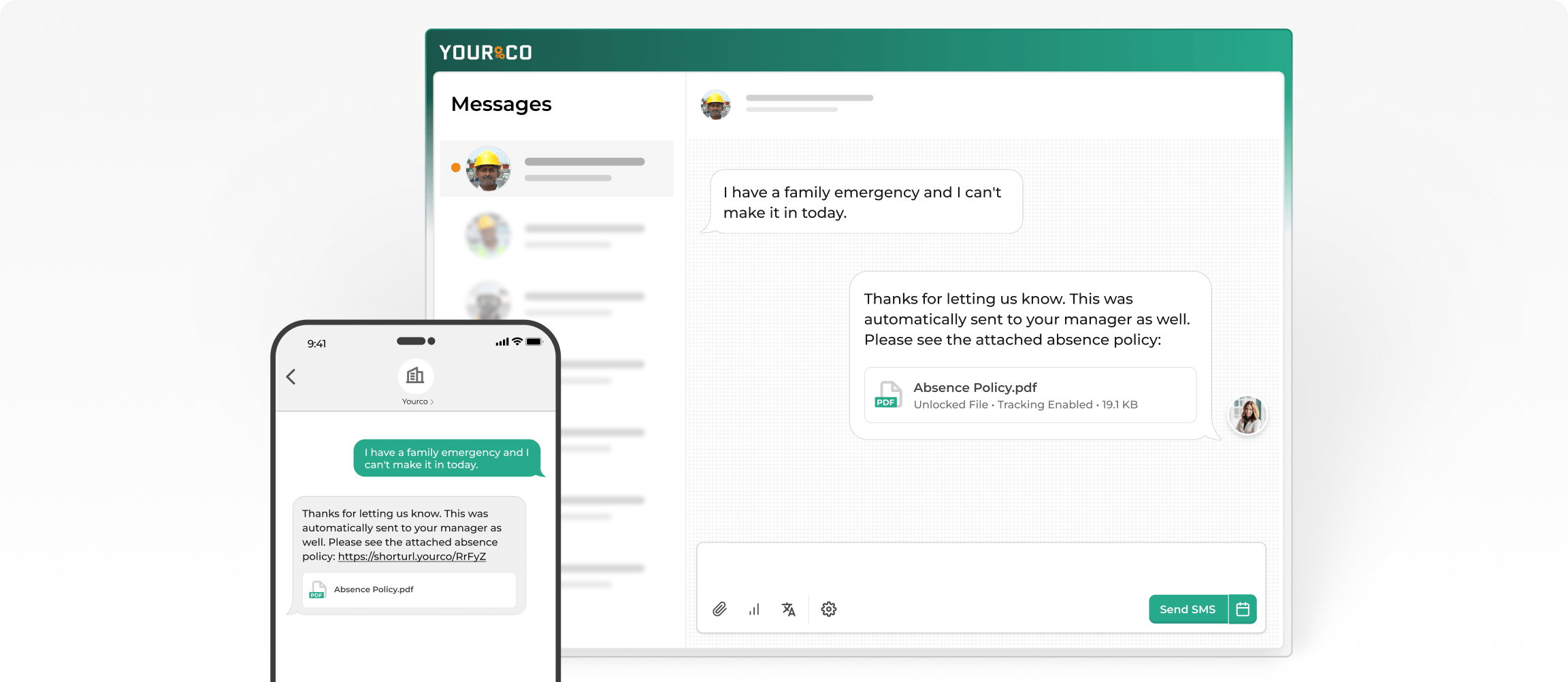
Your acknowledgment should go out as soon as possible, confirming receipt and outlining the next steps. For frontline workers without email access, use a channel they actually check, like SMS. A compliant acknowledgment includes confirmation that the request was received, a summary of what documentation the employee needs to submit, and a direct contact for questions.
Step 2: Provide a comprehensive leave policy summary
Under federal guidelines, the first notice (DOL Form WH-381) typically includes eligibility status, certification requirements, job restoration rights, and other key details about the employee's rights and responsibilities. A second notice (DOL Form WH-382) is typically provided within five business days after obtaining sufficient information to determine FMLA qualification.
For multilingual frontline teams, this step is where communication often breaks down. A policy summary that only exists in English on an intranet won't reach the warehouse worker whose primary language is Spanish. Consider these essentials:
- Translate FMLA and leave documents into the languages your workforce speaks
- Use SMS as the primary delivery channel for workers without email access
- Coordinate message delivery with shift change times so employees can engage with the information
- Include a direct phone number employees can text or call with questions
Maintain Compliant Contact During Leave
Once leave begins, communication doesn't stop, but it must remain within legal boundaries. The line between a supportive check-in and FMLA interference is thinner than most managers realize, and thorough documentation protects everyone involved.
Step 3: Schedule empathetic check-ins via the employee's preferred channel
A practical compliance guideline known as the "response time test" suggests that the longer it takes an employee to respond to a work-related question, the more likely it is that the contact crosses into FMLA interference. Brief administrative check-ins are generally permissible, but anything requiring significant response time likely crosses the line.
Base your check-in frequency on the nature of the leave and the employee's preferences. Default to less contact when in doubt. A compliant check-in might read:
"Hi Maria, this is HR. Your colleagues are covering the current project, so no need to worry. We hope recovery is going well. Reach out if you have questions about benefits or paperwork. No response needed."
What crosses the line? Federal courts have found interference when employers asked employees on FMLA leave to perform 20 to 40 hours of work, update compliance cases, or continue making work assignments.
Step 4: Document every interaction with timestamps
FMLA regulations generally require employers to retain leave records for at least 3 years. Every communication should be logged with the date, time, method, participants, and a content summary. Medical certifications and recertifications are typically maintained in separate, confidential medical files, not in general personnel folders. For shift-based workforces, timestamps are especially important for tracking when requests were received and when required notices were delivered.
Prepare Accommodation Discussions Before the Return Date
The transition back to work is where FMLA and ADA obligations overlap, and where many employers stumble. Starting the conversation early gives you time to assess essential job functions, explore accommodations, and avoid last-minute decisions that create legal risk.
Step 5: Plan return-to-work accommodations early
The intersection of FMLA fitness-for-duty guidelines and ADA accommodation obligations creates one of the most complex areas in leave management, especially for physically demanding roles.
Employers with a uniformly applied fitness-for-duty policy may require certification upon return, and an "enhanced" approach can address the employee's ability to perform specific essential job functions rather than just provide generic clearance. Key points that trip up frontline employers:
- Avoid '100% healed' policies. The EEOC has specifically objected to requiring zero medical restrictions before allowing an employee back to work.
- Conduct individualized assessments. Safety concerns should be specific and evidence-based, not generalized assumptions.
- Consider temporary accommodations. Even if permanent modifications aren't feasible, temporary accommodations during a transition period may be appropriate.
- Explore reassignment to vacant positions. If a construction worker can no longer work at heights, dispatch, quality control, or administrative roles may be viable options.
A return-to-work message might read: "We received your healthcare provider's certification and would like to schedule a meeting to discuss your return. We'll review your position's essential functions and work together to identify any needed accommodations. Let us know a good time this week."
For specific compliance guidance, consult with qualified legal professionals.
Train Managers on Privacy and Legal Boundaries
Supervisors are your first line of defense and your biggest liability. A single offhand comment about an employee's medical condition or an overly aggressive check-in during leave can expose the organization to costly litigation. Formal training turns risky instincts into compliant habits.
Step 6: Equip every supervisor with clear communication rules
SHRM has reported to the Department of Labor that HR professionals struggle with FMLA compliance, and if dedicated HR professionals find it challenging, the risk is exponentially higher for frontline supervisors with no HR background.
Many employers establish manager training that covers these boundaries:
- Avoid contacting an employee's healthcare provider directly. Many organizations restrict medical certification clarifications to HR, and only after the required cure period has passed.
- Recognize leave triggers without waiting for magic words. Statements like "my back is really bothering me" can trigger protected leave rights. The recommended response is always to notify HR immediately.
- Keep medical details confidential from the team. When coworkers ask why someone is out: "[Employee] is on approved leave. I can't share details."
- Avoid requesting substantive work during leave. This includes reviewing blueprints, updating reports, or attending meetings.
Provide supervisors with quick-reference cards, decision trees for when to involve HR, and a direct HR hotline for real-time questions. Annual refresher training keeps these boundaries top of mind as regulations evolve.
Automate Tracking and Close the Loop After Return
As leave volumes rise, manual processes break down. Automating compliance deadlines prevents missed notices, and a structured debrief after the employee returns captures lessons that strengthen your process for the next request.
Step 7: Use your HRIS to automate compliance deadlines
More than 55% of HR leaders reported increased leave request volume in both 2024 and 2025. Manual tracking at that scale invites missed deadlines. For frontline organizations, the critical HRIS evaluation criteria include mobile accessibility for floor managers and shift workers, SMS notification options for employees without email, and integration with existing timekeeping and payroll systems.
Step 8: Conduct post-return debriefs
A brief conversation after an employee returns can confirm accommodations are in place, answer lingering questions about benefits, and surface what worked and what didn't, generating insights that strengthen your process over time.
Use this quick compliance checklist to verify your leave communication process covers the essentials:
- Acknowledgment sent within one business day of learning about the leave need
- Eligibility and rights notice (WH-381) delivered within five business days
- Designation notice (WH-382) delivered within five business days of obtaining sufficient information
- All communications are logged with date, time, method, and content summary
- Medical records are stored in separate confidential files
- Managers trained on privacy boundaries and leave triggers
- Return-to-work accommodations discussed before the employee's expected return date
- Post-return debrief completed to confirm accommodations are in place
For specific compliance guidance, consult with qualified legal professionals.
Reach Every Employee on Leave With Yourco
Managing medical leave across eight steps, from initial acknowledgment through post-return debriefs, requires consistent, timely communication at every stage. When your workforce operates on production lines, job sites, or delivery routes, traditional email-based channels simply don't reach them.
Yourco's SMS-based platform delivers leave acknowledgments, policy summaries, check-in messages, and return-to-work updates directly to any mobile phone, including basic flip phones, with no app download, no WiFi, and no cost to the employee. AI-powered translation supports multilingual workforces, so every worker automatically receives critical leave information in their preferred language.
For compliance documentation, Yourco archives every message with timestamps, creating the audit trail that FMLA recordkeeping demands. Targeted messaging lets HR reach specific employees with individualized leave notices, and automated scheduling ensures messages arrive at the right time for each shift. Yourco connects to 240+ HRIS and payroll systems for automated employee data syncing, and its Enterprise Bridge enables seamless integration with your existing workplace systems.
Yourco's Frontline Intelligence gives HR teams centralized visibility into medical leave trends across locations. Track how many employees request leave each month, identify patterns by site or department, and better understand the underlying reasons driving leave requests. These insights support proactive workforce planning and strengthen compliance reporting.
"We're loving Yourco so far! We use Yourco's services for our absence management and for sending out notices, reminders, and event announcements to our employees. It keeps everyone who needs to know informed when people are absent. We also really like that we can schedule messages and receive notifications when someone messages the phone number. If you have multiple supervisors, it's nice to be able to set up notification settings so messages are only received at the times the supervisor has chosen. This is an amazing service that I recommend to anyone who wants to make improvements."
— Kyle Stover, HR Assistant, J-Lenco Inc.
After using Yourco for 90 days, two-way employee engagement increased to 86%, creating the consistent, reliable communication that makes leave management work across shifts and locations.
Try Yourco for free today, or schedule a demo to see the difference a right workplace communication solution can make for your company.
Frequently Asked Questions about Managing Medical Leave Requests
Can managers contact employees who are on FMLA leave?
Brief administrative check-ins and wellness messages are generally considered permissible. However, asking employees to perform substantive work tasks during leave can constitute interference with FMLA. Many employers route all leave-related communications through HR to reduce risk.
How quickly does HR need to respond to a medical leave request?
Many employers follow a federal framework with two key notice deadlines within five business days of learning about the leave need. The first confirms eligibility and outlines employee rights; the second designates whether the leave qualifies for protection.
What should HR document during the medical leave process?
Best practices include logging every leave-related interaction with dates, times, participants, communication method, and content summary. Medical records should be kept in separate confidential files, not in general personnel folders.
How do you communicate leave policies to employees without email?
SMS-based platforms like Yourco reach workers on any mobile device without requiring downloads or internet access. For multilingual teams, automated translation helps ensure every employee receives policy information in their preferred language.
What are the biggest mistakes employers make during the return-to-work process?
A common mistake is requiring employees to return with no medical restrictions before allowing them to return to work. Instead, many employers engage in an individualized process to identify reasonable accommodations that support a successful return to work.


