
Training systems designed for desk workers exclude most of the global workforce. Roughly 80% of the world's workforce does not work at a desk, according to the O.C. Tanner 2024 Global Culture Report. The cost shows up in slower time-to-productivity, higher compliance risk, and turnover that accelerates before new hires reach their 90th day.
This article breaks down why traditional training infrastructure fails frontline teams and walks through the practical fixes, from mobile-first microlearning and AI-driven personalization to weekly micro-feedback, structured preboarding, and the SMS-based communication channels that hold it all together.
TL;DR
- Traditional LMS platforms were built for desk workers and miss frontline teams without email or screen time
- Microlearning delivered through mobile channels fits the short windows that frontline workers have between tasks
- AI-driven personalization adjusts training content to individual skill gaps in real time, replacing one-size-fits-all curricula
- Gamification and immersive virtual reality (VR) simulation improve safety training for manufacturing, construction, and logistics teams
- Weekly micro-feedback from managers drives higher engagement than annual performance reviews, especially for shift-based teams
- SMS-based platforms like Yourco deliver training reminders, onboarding sequences, and policy updates to any phone, no app required
Recognize Why Traditional Training Infrastructure Fails Frontline Teams
Frontline training often fails because it assumes desktop access, a corporate email login, and long, uninterrupted sessions that warehouse associates, line cooks, and construction crews lack. As Training Industry has noted, traditional learning tools were never designed with this workforce in mind.
Research from the Society for Human Resource Management (SHRM) found that retention is especially difficult for frontline workers in the first year, with 53% of HR professionals identifying that period as the hardest. By contrast, office-based employees are typically more at risk of leaving after year one and before year three.
That early window is also fragile because managers are often stretched thin, coaching time is scarce, and onboarding is overloaded, leaving new hires to figure things out on the job.
Formal training hours are also declining. Employees averaged 13.7 hours of formal learning in 2024, down from 17.4 hours in 2023, according to the ATD report. That shrinking investment leaves little room for training that does not fit the realities of frontline work.
The infrastructure itself assumes a type of worker and a type of workday that do not exist on the factory floor, the delivery route, or the hospital ward. Until training design starts from the conditions frontline workers actually face, organizations risk completing modules without building real competence.
Deliver Microlearning Through Mobile-First Channels
Frontline workers do not have long training blocks. They get five minutes before a shift change, three minutes between deliveries, or a quick break on the warehouse floor. The LinkedIn Workplace Learning Report 2025 identifies microlearning as a primary tool for training this workforce, with companies adopting mobile-first platforms that support learning during downtime or in transit.
Microlearning works for frontline teams when it follows a few core design principles:
- Design for interruption: each module should be completable in a single sitting with automatic progress saving
- Eliminate email logins by using SMS-based enrollment or direct app pushes for distribution
- Combine spaced repetition with initial onboarding so microlearning reinforces, rather than replaces, hands-on training
- Enable full offline access for environments with unreliable connectivity, such as plant floors or remote job sites
- Localize content into each worker's primary language to close comprehension gaps in diverse, multilingual frontline teams
When organizations follow these principles, training becomes easier to complete and reinforce on the job.
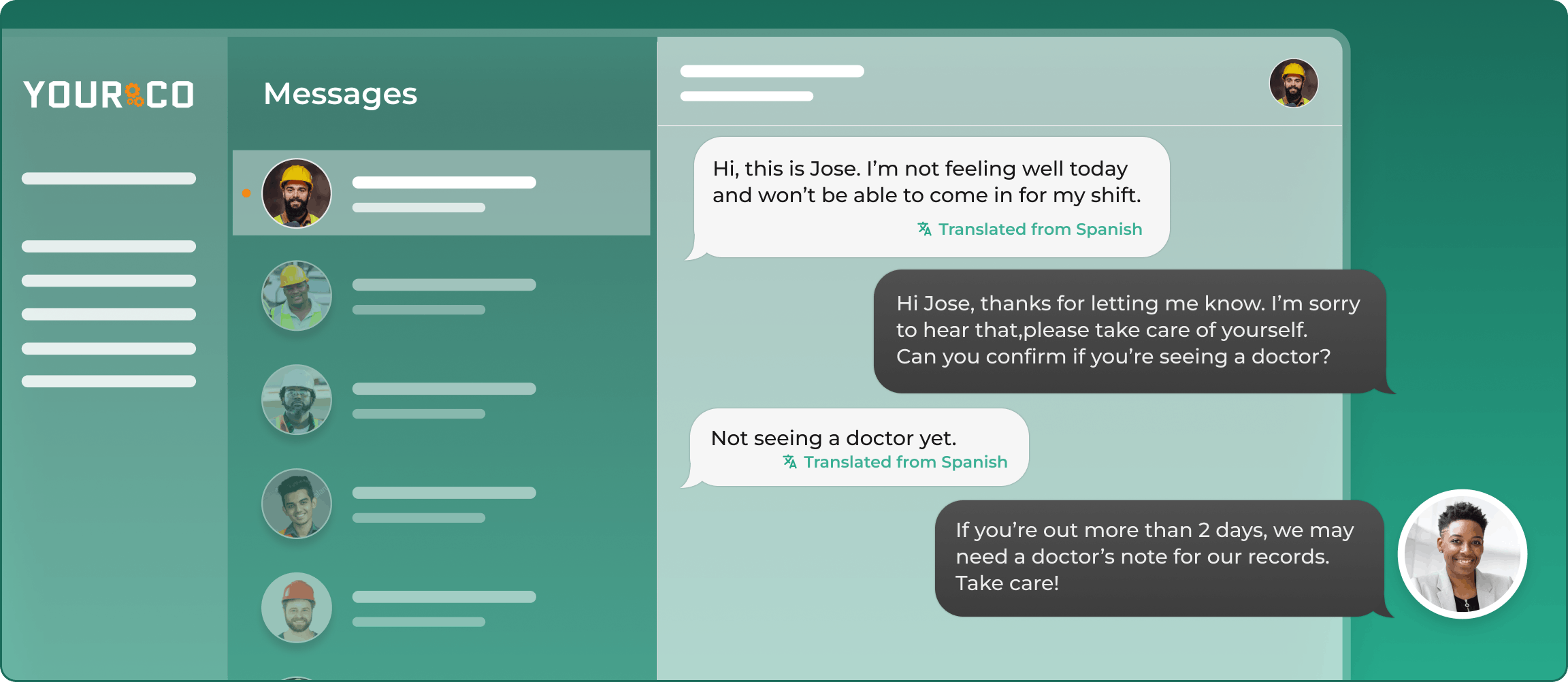
Apply AI-Driven Personalization to Close Individual Development Needs
AI personalization tailors content difficulty, sequencing, and format to individual performance, replacing one-size-fits-all curricula that treat every new hire the same regardless of prior experience, role complexity, or learning pace.
Gartner predicts that task-specific AI agents will appear in 40% of enterprise applications this year, up from less than 5% in 2025, enabling training platforms to customize onboarding based on assessment results. One example of this pattern is agentic training tools that adjust content pathways as learners progress. Deloitte Insights notes that Johnson & Johnson uses AI to infer skills across its workforce as part of broader workforce planning, helping leaders pinpoint development gaps and connect employees to new career paths.
Use Gamification and Immersive Simulation for High-Stakes Skills
Slide-based safety training produces completion certificates that rarely change behavior on the job. Realistic practice does.
VR-based training has been shown to improve safety knowledge, risk perception, and overall task performance compared to traditional methods in manufacturing settings, according to a peer-reviewed Scientific Reports study. In construction, peer-reviewed ASCE research found that workers trained through VR performed better on task execution and demonstrated higher motivation than conventionally trained peers. That study also validated an observer model in which multiple trainees watch one immersive simulation, producing comparable learning outcomes at lower cost.
Each training method has a different fit for frontline work, depending on the skill and the environment.
The table below compares the most common formats across strengths, weaknesses, and best use cases.
Choosing the right mix depends on the skill being taught, the environment workers operate in, and how often that knowledge needs to be refreshed once initial training ends.
Replace Annual Reviews With Weekly Micro-Feedback
Annual performance reviews assume stable roles, predictable goals, and a manager who remembers twelve months of context. None of those assumptions holds for shift-based frontline teams with rotating schedules and high turnover.
Employees who receive weekly manager conversations are four times more likely to be highly engaged than those who receive feedback annually, according to Gallup, whose broader State of the Global Workplace research consistently links feedback frequency to engagement outcomes. For frontline organizations losing workers in the first 90 days, weekly check-ins directly address the window where disengagement turns into resignation.
Practical micro-feedback depends more on consistent managerial behavior than on complex software. A few habits make it work:
- Weekly or biweekly one-on-ones focused on goal progress rather than evaluative scoring
- Real-time recognition tied to the triggering event, not saved for a quarterly summary
- Two-way communication that incorporates the employee's own self-assessment of readiness and challenges
Because frontline workers lack consistent access to email or desktop systems, feedback tools must be mobile-first by design. 91% of HR leaders view SMS as an effective channel for reaching frontline workers, according to a Yourco-commissioned survey of 150 HR leaders, which makes text-based check-ins a natural fit for distributed teams.
Start Training Before Day One With Structured Preboarding
The period between offer acceptance and the first shift is a retention risk. SHRM research shows that strong onboarding improves retention and productivity, and preboarding extends that support window earlier by helping new hires understand what to expect before day one.
For frontline roles, preboarding should reach workers on their personal devices via channels such as SMS onboarding sequences, which can deliver welcome messages, first-week schedules, and document-collection steps without introducing technology barriers. Language-friendly onboarding can further reinforce expectations across multilingual teams.
Measure What Matters and Shift From Completion Rates to Behavioral Outcomes
Training Industry argues that Learning and Development (L&D) leaders should move beyond completion rates and connect programs to concrete business outcomes. For frontline training, the most useful metrics are operational:
- Time-to-proficiency: how quickly a new hire reaches full productivity
- Safety incident rates before and after training interventions
- Retention during early onboarding
- Manager coaching frequency linked to engagement scores
Many frontline employees would stay longer if they had career support and learning opportunities, according to SHRM Labs. A Yourco-commissioned survey of 150 HR leaders found that only 36% were satisfied with their current employee communication apps, suggesting room for improvement in how feedback and training data are delivered to managers. Connecting employee feedback data to observable behavioral change strengthens the business case for training investment.
This information is for general awareness only. For specific compliance guidance, consult with qualified legal professionals.
Reach Every Frontline Worker Instantly With Yourco
Training programs only work when the communication reaches the worker. Yourco gives enterprise organizations an SMS-based channel that connects with every frontline employee, on any phone, without requiring an app download or corporate email address.
Core capabilities include:
- SMS to any phone, including basic flip phones, with no app, no Wi-Fi, and no cost to employees
- Two-way messaging between managers and their teams for feedback, questions, and training follow-up
- AI-powered translation across 135+ languages and dialects, so safety protocols and SOPs reach every worker in their preferred language
Yourco integrates with 240+ HRIS and payroll systems, syncing workforce data so that onboarding sequences are triggered the moment a new hire is added to the system.
Enterprise Bridge enables corporate leadership to broadcast training updates, policy changes, and compliance announcements to every frontline location simultaneously through a one-way corporate communication layer. Two-way messaging keeps local managers in direct conversation with their teams.
Frontline Intelligence gives L&D and HR teams centralized visibility into training communication patterns across all locations. It surfaces which sites have the strongest new-hire engagement, identifies where onboarding messages go unanswered, and tracks sentiment trends across the organization so leadership can prioritize follow-up.
"Yourco has allowed us to scale frontline employee communications through rapid growth of the organization, while driving increased levels of engagement, employee retention, and productivity. We use it daily for HR and operational communications at the local level, and for organization-wide communications and frontline employee data analysis at the corporate level. The ease of use and implementation has driven full adoption across our workforce, becoming our most effective frontline employee communication channel."
— Madison Farrell, Director of Culture and Internal Communications, Great Day Improvements
After 90 days on Yourco, companies see two-way employee engagement reach 86%.
Try Yourco for free today, or schedule a demo to see the difference the right workplace communication solution can make for your company.
Frequently Asked Questions About Frontline Training
How do you train frontline workers who don't have company email addresses?
SMS-based platforms like Yourco train frontline workers without a company email by delivering reminders, onboarding steps, and policy updates directly to their mobile phones. That approach removes the need for a corporate login, an app download, or internet access, making it easier to consistently reach shift-based teams.
What is the best training format for shift-based workers?
Microlearning is usually the best fit for shift-based workers because it aligns with the short windows they have between tasks. Short modules are easier to complete, revisit, and reinforce on the job than longer classroom or desktop-based sessions.
How do you measure frontline training effectiveness beyond completion rates?
Measure frontline training effectiveness through operational outcomes such as time-to-proficiency, safety trends, and onboarding retention. Those measures show whether workers are becoming more capable on the job, rather than only whether they finished a module.
Can VR training work at scale for frontline teams?
VR training can work at scale when organizations use it for high-stakes scenarios where realistic practice matters most. A shared observer model also makes rollout more practical by allowing multiple trainees to learn from the same simulation rather than requiring one headset per person.
Why does preboarding matter for frontline worker retention?
Preboarding matters because the time between offer acceptance and the first shift is a common drop-off point for new hires. Early communication through SMS or other mobile channels builds connection, sets expectations, and helps workers arrive better prepared for day one