


TL;DR
Choosing an engagement tool depends on your workforce composition. SMS-based platforms like Yourco work best for frontline teams without regular computer or email access, achieving 98% read rates compared to 20% for email. Recognition platforms like Nectar and Bonusly excel at building team spirit through peer-to-peer appreciation. The most effective approach combines accessibility with measurement, ensuring every employee can participate and every interaction generates actionable data.
Reach Every Worker With Universal Mobile Access
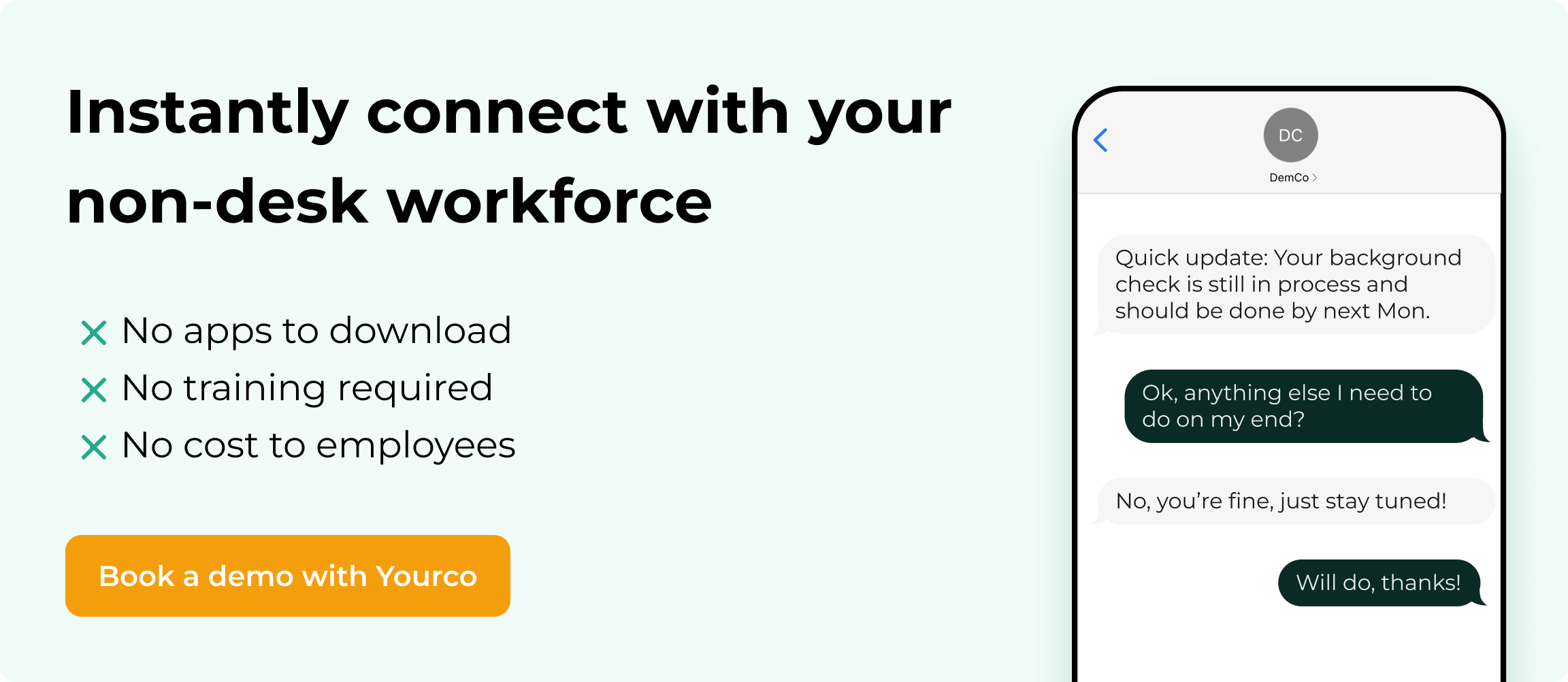
SMS-based communication reaches construction workers more reliably than mobile apps or email because it works on any phone without downloads, functions in areas with poor connectivity, and achieves 98% read rates. The best approach combines mobile apps for daily coordination with SMS as a backup channel for emergency alerts, supported by AI-powered translation and compliance documentation.
Most construction workers already carry smartphones and use them every day to check schedules, report from the field, and stay connected to their crews. Over 85% of construction workers own smartphones and use them daily for field reporting, safety alerts, and schedule updates. Technology adoption is strong: 69% use mobile software for field reports, 56% access customer data in the field, and over 80% use cloud platforms.
The technology is there. But having phones doesn't automatically mean your messages are getting through.
What stops messages from reaching workers? Spotty connectivity at remote sites. Too many different apps that don't talk to each other. And workers at different experience levels who need different levels of tech support. Digital literacy variations exist across the workforce, with younger workers typically demonstrating higher comfort with technology, while education level correlates with better digital skills.
The real challenge isn't getting workers to use technology. It's making sure your different tools work together and that your messages actually reach everyone, whether they're tech-savvy or not.
Communication platforms designed for frontline workers address this gap by using mobile apps as the primary channel for daily operations, field reporting, and detailed communications while maintaining SMS as a critical backup for emergency alerts that must reach every worker regardless of phone type or connectivity, achieving 98% read rates typically within five minutes. This multi-channel approach ensures emergency notifications reach your entire workforce regardless of phone type or connectivity.
When choosing a communication platform for construction crews, consider these factors:
- Battery drain matters on long shifts, so lightweight SMS uses less power than apps running in the background
- Older workers often prefer texting over navigating unfamiliar app interfaces
- Subcontractors may refuse to download yet another app but will respond to texts immediately
- Seasonal workers need instant access without onboarding delays or password resets
Keep Crews Safe With Instant Emergency Alerts
Every year, more than a thousand construction workers don't make it home, making construction the most dangerous industry for workplace fatalities. Many of these tragedies trace back to one problem: the safety message never reached the worker. Construction accounted for 1,075 worker deaths in 2023, representing 20% of all U.S. worker fatalities.
Studies show that 85% of fatal fall incidents among Hispanic construction workers were associated with not using required personal protective equipment, and 70% of all fall incidents involved lack of PPE. These statistics indicate fundamental breakdowns in communicating safety requirements and protective equipment usage.
Best practices from leading construction companies emphasize equipping employees with two-way radios featuring Man Down detection and Emergency Alert buttons for immediate safety communication, and implementing multi-channel emergency broadcast systems that include SMS alerts to reach workers universally. SMS provides a critical backup channel that reaches workers between sites, during off-hours, or when equipment fails, particularly important for workers with basic phones, older workers, or multilingual teams who may face barriers to mobile app adoption.
The investment paradox is striking: despite safety education accounting for 59% of workforce development investment, persistent high fatality rates raise critical questions about communication effectiveness. The message must actually reach workers to influence behavior.
Effective emergency communication systems address these common failure points:
- Weather alerts must reach crews before they arrive at exposed job sites, not after
- Equipment failures need immediate broadcast to everyone in the affected zone, including nearby trades
- Near-miss reports should flow from the field to safety managers within minutes, not days
- Evacuation orders require confirmation that every worker received and acknowledged the message
Turn Daily Communication Into Actionable Workforce Insights

Construction leaders make decisions every day based on incomplete information. Quarterly surveys arrive too late. Manager reports filter and dilute what's really happening on job sites. By the time you hear about a crew's frustration or a recurring safety concern, the problem has already cost you time, money, or worse.
Frontline Intelligence changes this by transforming everyday communication into real-time insights. Every text message, safety report, and schedule confirmation generates data that reveals patterns across your workforce. Instead of guessing which crews are struggling or which sites have emerging risks, you can see it clearly and act before small issues become major problems.
AI-powered analytics scan your daily communication to surface trends that manual review would miss:
- Spot disengagement signals before they turn into turnover by tracking response rates and message activity by crew and location
- Flag safety concerns and conflict indicators in real time by scanning messages for high-risk language patterns
- Identify attendance patterns and absenteeism hotspots across crews, shifts, and job sites
- Compare performance across locations to find which sites resolve issues quickly and which need support
- Forecast labor needs by analyzing task completion rates, absenteeism trends, and turnover patterns
Leaders can prompt the system directly with questions like "What's employee sentiment been like across our Northeast sites this month?" or "Have there been safety concerns reported at the downtown project?" The AI surfaces location-level answers based on actual frontline data, not secondhand reports.
This visibility helps CHROs, COOs, and site managers make data-backed decisions. You catch warning signs early, reinforce what's working, and support crews that need attention before problems compound.
Break Through Language Barriers With Multilingual Support
Approximately 25% of construction workers are foreign-born, creating significant language barriers that impact safety, compliance, payroll accuracy, and employee satisfaction. When a crew member can't understand a safety alert in their language, they face more than twice the risk of fatal injury compared to English-speaking workers. That's not acceptable, and it's preventable. Language barriers prevent workers from understanding safety protocols, equipment instructions, and hazard warnings.
Language barriers also directly impact your ability to meet OSHA compliance requirements. Common industry practice following OSHA guidance includes maintaining employee alarm systems that provide immediate warning when hazardous conditions occur, with safety communications understood by all workers to satisfy regulatory standards. Visual communication tools (diagrams, color-coded tags, and pictograms) help communicate safety instructions universally, but written communications require proper translation.
While visual tools help, many communications require text: policy updates, schedule changes, benefits information, and detailed safety procedures. Multilingual construction workforces require systematic solutions including toolbox talks and safety materials in multiple languages, real-time translation for engagement, and emergency alerts delivered in workers' native languages to ensure safety and compliance.
Modern platforms use AI-powered translation to automatically deliver messages in each worker's preferred language, eliminating manual translation overhead and communication delays. This ensures your crew member, your equipment operator, and your carpenter all receive the same safety alert simultaneously in the language they understand best.
Multilingual communication goes beyond safety alerts to strengthen your entire operation:
- Benefits enrollment information reaches workers who might otherwise miss deadlines due to language confusion
- Payroll questions get resolved faster when workers can ask and receive answers in their native language
- Training completion rates improve when instructions are clear from the start
- Exit interview feedback becomes more honest and actionable when language isn't a barrier
Stay Connected at Remote Sites Without Internet
Construction sites frequently operate in areas with poor cellular coverage or no WiFi access. Early-phase projects, underground work, remote locations, and buildings with thick concrete or steel all create connectivity challenges. Yet communication cannot stop because internet access is unreliable, making offline synchronization and multi-channel communication systems essential for field operations.
Mobile apps with offline synchronization capabilities allow workers to access critical resources locally (including blueprints, safety protocols, and task information) when connectivity is unavailable. As a result, construction companies must implement a multi-channel communication strategy using redundant systems (mobile apps, SMS, two-way radios) to ensure critical information reaches workers regardless of connectivity status.
While mobile apps should serve as your primary communication platform for their rich features and documentation capabilities, SMS provides an essential backup channel. SMS requires only basic cellular network access and no internet connection, WiFi, or data plan, which are critical advantages for remote construction sites.
Remote site communication presents unique challenges that require specific solutions:
- Mountain terrain and valley locations often block data signals while voice networks remain functional
- Underground utility work requires communication plans that account for complete signal loss in tunnels
- High-rise construction creates dead zones on certain floors as the building takes shape
- Rural pipeline projects may span dozens of miles with inconsistent coverage throughout
Text messages function on the same voice network that enables phone calls, making them universally accessible even to workers with basic phones rather than smartphones. However, SMS has significant limitations as a primary communication channel due to message length restrictions, lack of multimedia support, limited interactivity compared to mobile apps, and absence of centralized documentation for compliance purposes. Construction companies should maintain SMS as a critical backup channel for emergency notifications and reaching workers with basic phones, while deploying mobile apps as the primary platform for daily field operations and detailed communications.
This explains why construction technology experts recommend a dual-channel approach: mobile apps as the primary platform for their superior features and adoption rates, with SMS maintained as a critical backup channel specifically for emergency alerts and reaching workers at remote sites or with basic phones.
Platforms designed for construction communication solve this by operating on basic cellular networks without internet requirements. Messages queue automatically and deliver when service returns, preventing communication blackouts at remote sites.
Connect Your Systems Automatically for Real-Time Updates
Construction companies already use specialized software for project management, and communication tools must integrate seamlessly to avoid data silos and duplicate data entry. The industry uses enterprise-grade platforms like Procore for project management, Autodesk Build for BIM integration, Fieldwire for field coordination, and dozens of other specialized systems.
Yourco works for organizations of all sizes, from small contractors with a single crew to mid-market companies expanding across regions to enterprise builders managing thousands of workers nationwide. Implementation takes days, not months, and you don't need IT support or dedicated administrators to get started.
High technology adoption paradoxically creates barriers when systems don't communicate with each other. "App fatigue" and "multiple disconnected platforms" remain top barriers to effective field communication despite widespread technology investment.
To address integration challenges, communication platforms should deliver real-time bidirectional sync between construction management systems and communication tools, enabling automatic updates on project status and schedules.
Key integration capabilities include elimination of manual data entry and workflow automation with notifications triggered by system events. These integration features prevent data silos and ensure that project information flows seamlessly between communication platforms and existing construction management systems like Procore, Autodesk Build, and Aconex.
Beyond construction-specific software, communication platforms should integrate seamlessly with existing workforce management and project management systems to ensure team visibility and data consistency. When workers are assigned to different job sites, crews, or shifts, your communication system should reflect these changes automatically by connecting with your construction management platform, eliminating manual updates and maintaining accurate, real-time crew information across all job sites.
A comprehensive employee communication solution for construction should integrate seamlessly with your existing systems, automatically syncing employee data, job assignments, and contact information. When your project management system updates crew assignments, the right communication platform ensures you can instantly message the right workers without manual list management. This integration prevents the communication silos that plague multi-system environments.
Poor integration creates specific problems that compound over time:
- New hires added to payroll but missing from communication lists don't receive critical first-week information
- Crew reassignments in project management software leave old supervisors messaging workers who moved to different sites
- Terminated employees remaining on distribution lists create security and compliance risks
- Schedule changes entered in one system but not reflected in alerts cause confusion and no-shows
Track Compliance and Document Safety Communications
Note: This information describes common industry practices for general awareness only. For specific compliance guidance applicable to your organization, consult with qualified legal and safety professionals.
After a safety incident, can you prove which workers received the hazard alert? Most traditional tools can't answer that question. Phone calls leave no record. Group texts scatter across personal devices. Two-way radios don't document who heard what. When OSHA comes calling or a dispute goes to court, "we told them" isn't enough. You need documented proof.
Communication platforms purpose-built for employee communication provide centralized documentation with timestamped records, delivery confirmation, read receipts, searchable message archives, and compliance reports. These capabilities transform communication from ephemeral conversations into documented safety management critical for construction compliance and incident investigation.
Documentation becomes especially valuable in these high-stakes situations:
- Workers' compensation claims often hinge on whether safety procedures were communicated before an incident
- Subcontractor disputes benefit from clear records showing which parties received change orders and when
- Union grievances resolve faster when you can demonstrate consistent communication across all crews
- Insurance audits require proof that safety training reminders reached the intended recipients
The average construction dispute costs $60.1 million with 12.5-month duration, with communication breakdowns identified as a common root cause. Proper documentation protects against these costly disputes while ensuring regulatory compliance.
Reduce Turnover Through Better Daily Communication
Construction industry turnover rates reached 56.9% in 2021, significantly above the all-industry average of approximately 12%. Poor communication drives workers away. When crews don't receive clear schedules, timely safety information, or feedback channels, they feel disrespected and disengaged, and they leave.
The impact is quantifiable: replacement costs for construction workers average 21% of annual salary. For a mid-level construction worker earning approximately $58,000 annually, that translates to roughly $12,000 per replacement. In a workforce experiencing turnover rates of 20-30% annually, these costs compound dramatically. For a 100-person field crew, annual turnover costs range from $240,000 to $360,000.
Better daily communication reduces turnover by setting clear expectations, sharing schedules transparently, demonstrating safety commitment, enabling feedback, and fostering connection.
Workers require clear visibility into project timelines and work expectations. When schedule changes arrive late or not at all, workers feel disrespected and disengaged. When safety communications fail to reach them, they may question management's commitment to their well being.
These communication gaps create dissatisfaction that drives turnover. Poor communication practices contribute significantly to turnover in construction. Beyond turnover miscommunication contributes to 48% of all project rework, costing the construction industry over $31 billion annually in labor and materials.
Beyond emergency broadcast systems and safety alerts, comprehensive communication (including multilingual support, clear role expectations, accessible feedback systems, and transparent schedule communication) impacts worker retention. Clear communication of role expectations, transparent scheduling, and accessible two-way feedback systems contribute to workers feeling connected and valued.
Small communication improvements create outsized retention benefits:
- Sharing next week's schedule by Thursday gives workers time to arrange childcare and transportation
- Acknowledging good work publicly through team messages builds loyalty faster than annual reviews
- Asking for input on process improvements makes workers feel invested in the company's success
- Responding promptly to questions signals that management values workers' time and concerns
Connect Your Entire Workforce in Seconds With Yourco
Construction crews need communication that works everywhere, from remote sites to underground work areas. Yourco solves this with SMS-based messaging that reaches every worker on any phone type, from smartphones to basic flip phones, without requiring app downloads or internet connectivity.
Yourco's platform is built specifically for construction workforces with diverse needs. The AI-powered translation engine automatically converts your messages into 135+ languages and dialects, ensuring your workers all receive critical safety alerts in their preferred language simultaneously. Seamless integration with your construction management systems and HRIS platforms keeps employee data synchronized automatically.
When crew assignments change in Procore or Autodesk Build, Yourco updates instantly. Every message creates a timestamped, searchable record with delivery confirmation and read receipts, giving you the compliance documentation needed for OSHA inspections and dispute protection. Workers can respond directly through text, report absences, and provide feedback, creating true two-way communication.
Try Yourco for free today or schedule a demo to see the difference the right workplace communication solution can make in your company.
When should I use SMS versus mobile apps for my construction crew?
Use mobile apps as your primary platform for daily coordination, task assignments, and detailed information. Reserve SMS for urgent safety alerts that must reach everyone immediately, especially when internet connectivity fails. SMS reaches every phone type without downloads or logins, making it your critical backup for emergencies.
How do you handle language barriers with diverse construction crews?
Look for communication tools with built-in translation that automatically converts messages into each worker's preferred language. Combine this with visual aids like diagrams and color-coded safety tags. This dual approach helps ensure everyone understands critical information.
What do construction workers prefer: apps or text messages?
Most construction workers check their phones regularly and find both useful. Mobile apps work best for daily coordination with photos, documents, and detailed task information. Text messages excel for urgent updates that need immediate attention. Smart companies use both: apps for primary communication, texts for critical alerts.
What communication features help with safety compliance?
Look for systems that automatically save records of safety alerts with timestamps and confirmation that workers received them. Searchable message history helps you find past communications quickly. These features support your documentation needs during inspections and provide audit trails for accountability.
What are the costs of poor communication in construction?
Poor communication drives up costs through project delays, rework on tasks done incorrectly, and worker turnover from frustration. Better communication tools typically pay for themselves by preventing just a few of these costly problems across your projects and workforce.


