

When union members miss critical contract updates, ratification votes fail, and trust erodes. This challenge intensifies for manufacturing, logistics, construction, and transportation operations, where workers span multiple shifts, job sites, and languages, often without access to company email. With SMS achieving 98% open rates, multi-channel communication is essential for reaching every member. This guide walks through seven practical methods to ensure every union member receives, understands, and can act on contract updates.
TL;DR:
- Build opt-in contact lists with TCPA consent and language preferences before negotiations begin.
- Use SMS as your primary distribution channel. SMS-based tools such as Yourco reach every mobile phone, including basic devices, without requiring an app download or a data plan.
- Supplement SMS with a dedicated union website, social media groups, virtual town halls, PDF summaries, and member portals.
- For multilingual workforces, AI-powered translation and two-way messaging help ensure every frontline worker receives contract updates in their preferred language.
- Stay compliant with TCPA, CAN-SPAM, and NLRA guidelines by consulting qualified legal professionals for specific requirements.
Build Opt-In Contact Lists Before Negotiations Begin
Effective contract distribution requires preparation long before bargaining concludes. According to CWA's collective bargaining communications framework, unions benefit from establishing comprehensive, permission-based contact lists during the pre-bargaining phase, including mobile phone numbers for SMS delivery, email addresses, and physical mailing addresses.
Systematically survey members during routine union activities to collect preferred contact methods, personal mobile numbers (with documented TCPA consent), and language preferences. For multilingual workforces, document language preferences during initial data collection rather than resorting to ad hoc translation when urgent updates are needed. Language barriers cost manufacturers over $500,000 annually when bilingual employees are repeatedly pulled from their primary roles to translate for coworkers who are limited English proficient.
Consider these list-building tactics:
- Collect contact preferences and express written consent for SMS messaging during membership meetings.
- Maintain contact verification processes during annual dues renewal.
- Train stewards to update member contact information during routine workplace interactions.
- Include QR codes on bulletin board flyers linking to mobile-optimized contact update forms.
- Offer multiple input methods (paper forms, SMS text-to-join codes, member portal updates).
These systematic approaches ensure your contact database remains current and compliant while building multiple pathways for members to stay connected.
Example opt-in message template: "[UNION NAME]: Text JOIN to confirm your contact info for contract updates. Reply LANG + your language preference (e.g., LANG Spanish).”
Pros: Ensures TCPA compliance from the start; creates segmented lists by language and shift; enables targeted communications based on member preferences
Pitfalls: Requires significant upfront time investment; contact info decays quickly without maintenance; some members may resist sharing personal numbers
Create a Dedicated Union Intranet for Contract Access
A centralized digital hub gives members 24/7 access to contract documents, summaries, and supporting materials without requiring IT resources to build and maintain a separate website. Yourco lets union leadership upload and store critical documents directly on the platform, with members accessing files through secure, PIN-protected links delivered via SMS.
Effective union intranet platforms include several core elements that serve members across all shifts:
- Centralized document storage for full contract text, plain-language summaries, and side-by-side change comparisons
- Searchable files and archived communications so members and stewards can quickly locate specific provisions or past updates
- Passwordless authentication that removes forgotten-password barriers for workers accessing documents between shifts
- Contact information for stewards and union leadership so members always know who to reach with questions
- FAQ sections and recorded town hall sessions for on-demand reference
- Secure PIN-protected links delivered via SMS for immediate mobile access on any phone
These features transform your documentation hub from a static file repository into an accessible resource that members can reach whenever questions arise, without a separate portal to learn or a new login to remember.
Pros: Available 24/7 for all shifts; creates a single source of truth; searchable for specific provisions; no separate website to build or maintain; passwordless access removes login barriers
Pitfalls: Documents must be edited externally before uploading; requires initial effort to organize and upload existing contract materials
Send SMS Alerts for Instant Union Contract Updates
SMS text messaging achieves 98% open rates with messages typically read within minutes, drastically outperforming email. This makes SMS particularly effective for time-sensitive contract communications reaching workers across all shifts, especially those without desk access or company email accounts.
Structure your SMS strategy around these principles:
- Lead with critical information in the first few words.
- Keep messages concise with clear calls to action.
- Include shortened links to detailed information.
- Consider timing to avoid disrupting sleep schedules across shifts.
- Enable two-way messaging so members can ask questions.
- Track delivery rates and engagement metrics to identify unreachable numbers.
Implementing these principles ensures your SMS messages cut through the noise and prompt immediate member action.
Example SMS templates:
"[UNION NAME]: New contract summary posted. Key wins: 4% wage increase, improved PTO. Full details: [LINK]. Vote opens Mon 6 AM. Reply to questions."
"[UNION NAME]: REMINDER - Contract vote closes TODAY at 8 PM. Haven't voted? Visit [LINK] or see your steward. Your voice matters."
For urgent updates, SMS serves as the immediate alert channel, with links to detailed information on member portals or email for deeper review. Many unions obtain express written consent from members before sending text-based updates, and standard practice is to honor opt-out requests immediately.
Pros: Near-instant delivery; works on any mobile phone, including basic flip phones; high open rates regardless of shift
Pitfalls: Character limits require linking to full details; TCPA compliance considerations are strict; per-message costs add up for large memberships
Use Social Media Groups for Supplementary Updates
While SMS and member portals are more effective for direct communication, social media groups, particularly Facebook Groups and Instagram Stories, work as supplements. Members who miss an SMS alert might catch information scrolling through their feed, and discussion threads help surface questions union leadership can address proactively.
Best practices for social media:
- Create private, members-only groups with verification.
- Post contract summaries with links to official union resources.
- Use Stories for time-sensitive reminders about voting deadlines.
- Share short video explanations of complex provisions.
- Monitor comments to identify widespread confusion.
- Always drive members back to official channels for authoritative information.
This approach leverages social media's organic reach while maintaining control over official communications.
Example social media post template: "CONTRACT UPDATE: Tentative agreement reached! Key highlights: [2-3 bullet points]. Full summary + Q&A recording now live on member portal → [LINK]. Town hall Thursday, 7 PM for all shifts. Questions? Drop them below."
Pros: Enables peer discussion and question surfacing; members can share updates organically; familiar platform requiring no new downloads
Pitfalls: Not all members use social media; privacy concerns with non-private groups; information can spread beyond membership
Host Virtual Town Halls With Recorded Sessions
Town halls provide high-impact opportunities for member engagement around complex contract provisions. Virtual formats extend the reach to members who cannot attend in person due to shift schedules or geographic distance.
Schedule multiple sessions across different days and times to accommodate all shifts. Many frontline workers cite poor timing as a primary barrier to communication.
Effective town halls should:
- Be announced through SMS, email, and social media with calendar invites.
- Allow anonymous question submission before and during meetings.
- Be recorded and posted to member portals within 24 hours.
- Provide live translation or captioning for multilingual workforces.
- Include follow-up written summaries distributed across all channels.
This comprehensive approach ensures no member is left behind, regardless of their schedule or location.
Example town hall announcement template: "[UNION NAME] CONTRACT TOWN HALL: Join us [DATE] at [TIME] to review the tentative agreement. Can't make it? Sessions also at [ALT TIMES]. Submit questions anonymously: [LINK]. Recording posted within 24hrs for all shifts."
Pros: Allows real-time Q&A and clarification; recordings extend reach to all shifts; builds trust through face-to-face interaction
Pitfalls: Technical difficulties can derail sessions; time zone coordination challenges; requires facilitation skills to manage effectively
Create Shareable PDF Summaries of Key Changes
Dense contract language creates comprehension barriers even for engaged members. One-page or two-page PDF summaries distill complex agreements into accessible formats that workers can review quickly and share with family members.
Design summaries for mobile viewing with large text and clear headers. Effective contract summaries include:
- Executive summary of significant changes in plain language
- Wage and benefit changes are displayed prominently with effective dates
- Side-by-side comparisons showing previous versus new provisions
- Visual callouts drawing attention to major wins
- Clear explanation of next steps (attend meetings, vote, etc.)
- QR codes linking to the full contract text
These elements make complex contract language accessible to all members while maintaining accuracy.
Example summary header template: "YOUR NEW CONTRACT AT A GLANCE | [UNION NAME] | Effective [DATE] ✓ Wages: [X]% increase over [X] years ✓ Benefits: [Key change] ✓ PTO: [Key change] VOTE BY: [DATE] | Questions? Text HELP to [NUMBER]"
Pros: Easy to share with family members; works offline once downloaded; distills complex language into an accessible format
Pitfalls: Static format can't be updated after distribution; requires design skills for professional appearance; may oversimplify nuanced provisions
Provide Personalized Access Through Member Portals
Member portals create personalized communication experiences. A senior worker approaching retirement has different contract concerns than a new hire, and frontline workers accessing information on personal devices have different needs than office-based employees.
Portals deliver value through five key capabilities:
- Personalized dashboards showing relevant contract provisions by classification
- Document libraries with searchable archives of current and past agreements
- Push notifications for new updates or approaching deadlines
- Secure messaging for confidential questions to union leadership
- Acknowledgment tracking confirming members reviewed critical documents
These capabilities create a tailored experience that addresses each member's specific contract concerns.
Pros: Personalized experience by classification; creates an audit trail of communications; secure channel for sensitive questions
Pitfalls: Requires app download or login credentials; higher implementation cost; members must actively check for updates
Stay Aware of TCPA, CAN-SPAM, and NLRA Considerations
Communicating with union members through multiple channels involves navigating three regulatory frameworks. The following is general awareness information, not legal advice.
TCPA considerations for SMS:
- Organizations must secure prior express written consent for marketing SMS and immediately honor opt-out requests when members text "STOP", a TCPA standard practice.
- Connecticut violations carry penalties of up to $20,000 per willful violation.
Note: FCC's one-to-one consent rule was struck down January 2025 by a federal court (11th Circuit). The April 2026 timeline now applies only to revocation rule expansions, not consent requirements. ActiveProspect TCPA Rules
CAN-SPAM considerations for email:
- Best practice includes accurate header information and non-deceptive subject lines.
- Most organizations provide clear opt-out mechanisms and valid physical postal addresses.
- Opt-out requests are typically processed within 10 business days.
NLRA considerations:
- Unions commonly respect collective bargaining rights and avoid interference with union activities.
- Standard practice is to maintain open communication with union employees and representatives.
- Organizations typically honor all negotiated contract terms.
This information is for general awareness only. Consult qualified legal professionals for specific compliance guidance.
Reach Every Union Member Instantly With Yourco
Distributing union contract updates across multiple shifts, locations, and languages demands communication infrastructure built specifically for frontline workers. SMS-based communication reaches every member on any mobile device, smartphones and basic flip phones alike, without requiring app downloads or data plans.
With SMS delivering near-universal reach and engagement, the right platform makes all the difference. Yourco's AI-powered translation across 135+ languages ensures contract updates reach multilingual workforces in each member's preferred language automatically. Two-way messaging lets members respond to updates, ask questions, and confirm receipt through simple text conversations. Message tracking documents exactly which members received critical contract information. Yourco also connects to 240+ HRIS and payroll systems for automated employee data syncing.
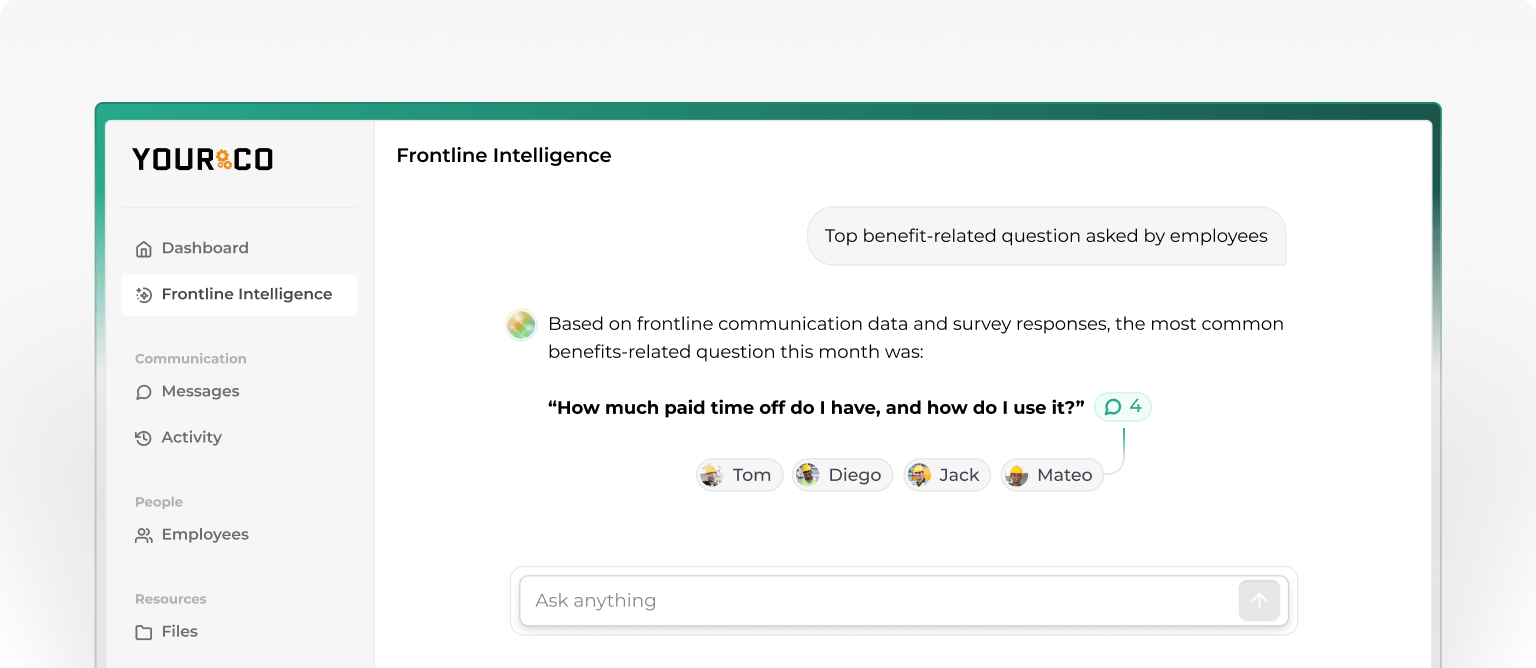
Frontline Intelligence gives union leadership deeper visibility into communication patterns and member engagement trends. Track which locations have higher response rates, identify common concerns raised in member replies, and analyze sentiment around contract updates in real time. Leadership can see how engagement varies by shift, department, or geography, helping union representatives proactively address issues, clarify misunderstandings, and strengthen member trust. Instead of guessing how updates land, you gain data-driven insight into overall communication effectiveness and emerging workforce trends.
"The Yourco texting system has helped the Railroad communicate with a 24/7 workforce. Sharing weather events, safety concerns and company bulletins have been priceless."
— Carl Kocur, Vice President of Engineering, New Orleans Public Belt Railroad
Transportation operations with 24/7 workforces find that SMS messaging solves the challenge of reaching employees who lack computer access. Manufacturing operations with large non-desk workforces report that quick, easy text communication finally creates reliable connections across all shifts.
"Yourco has helped to change the way we communicate at McCarthy Auto Group. We have nearly 700 employees and 80% are non-desk based, communication is a challenge. Yourco provides a quick easy way to reach everyone within our organization and a secure way for employees to reach HR and leadership without a computer."
— Felisha Parker, VP Human Resources, McCarthy Auto Group
After using Yourco for 90 days, two-way employee engagement increased to 86%, creating the consistent, reliable communication that builds trust necessary for successful contract ratification.
Try Yourco for free today or schedule a demo and see the difference the right workplace communication solution can make in your company.
Frequently Asked Questions about Distributing Union Contract Updates
How far in advance should unions start communicating about contract negotiations?
Begin building the communication infrastructure and updating member contact information well before the contract expires. This preparation ensures stewards understand their distribution roles and all communication systems are functioning properly before time-sensitive updates need to go out.
What is the most effective channel for reaching frontline union members?
SMS-based platforms like Yourco are the most effective channel because they reach workers on their personal mobile devices, which they already check frequently. Unlike email or apps, SMS reaches any mobile phone without requiring downloads, data plans, or company email accounts.
How can unions verify that members actually received contract updates?
Implement multiple verification methods, including SMS delivery confirmation with two-way response, member portal login tracking, document acknowledgment, and steward follow-up conversations. Tracking engagement across channels identifies members needing additional outreach before ratification votes.
What languages should contract summaries be translated into?
Survey your membership to identify all spoken languages, then prioritize translations by speaker count. Professional translation services are essential for contract documents because of the complex terminology of labor relations. AI-powered tools can assist with routine communications, while contract language may benefit from specialized professional translation.
How often should unions communicate during active contract negotiations?
Provide regular updates at least weekly during active bargaining, with immediate notifications for significant developments. Increase frequency as tentative agreements approach and ratification votes near, ensuring members receive detailed contract information through accessible channels before voting.


