
SMS is often cited as having very high open rates, with a 98% benchmark commonly referenced. That matters because a connected worker platform only delivers value when people can actually access it, and frontline workers have long been under-invested in compared to their desk-based peers.
Bersin analysis documents the scale of the frontline market and the investment gap between frontline and desk workers, a divide that industry research suggests can contribute to operational challenges, including higher error rates, more safety incidents, and extended time-to-productivity for new hires. This guide breaks down what a connected worker platform does, which capabilities matter most, and how to evaluate your options.
TL;DR
- Connected worker platforms help replace paper SOPs with digital workflows that link frontline employees to operational data, safety systems, and expert support
- IIoT and ERP integration can give technicians and operators live asset data at the point of work
- AR remote assistance connects frontline technicians with off-site experts for guided troubleshooting
- Safety compliance improves when hazard reporting, incident documentation, and audit trails are built into daily workflows
- AI-powered training and skills tracking can shorten onboarding and inform better staffing decisions
- SMS-based platforms like Yourco close the frontline communication gap, reaching employees on any phone without app downloads or Wi-Fi
What is a Connected Worker Platform?
A connected worker platform is designed to deliver real-time information, guidance, and collaboration tools to frontline employees while they perform their jobs. The category is generally defined by applications that bring real-time work instructions, operational data, and collaboration tools together in a single mobile-first interface designed for frontline roles. Specific capabilities and outcomes vary by vendor and deployment, but the common thread is putting decision-ready information in workers' hands at the point of work.
These platforms differ from generic collaboration tools in a fundamental way. They are built for people who work with their hands, often in environments with limited connectivity, shared devices, or no company email.
Forrester's Q4 2025 Human Capital Management (HCM) Wave calls on vendors to deliver industry-specific workforce management suites that cater to the unique needs and nuances of frontline workers, shifting the focus from traditional office roles to operational excellence on the ground. Bersin's January 2026 analysis points to a sizable spending disparity between frontline and white-collar workers in training and career growth, with frontline investment running well below what office employees typically receive.
That underinvestment shows up most visibly in the tools frontline teams use day to day. While office workers operate inside integrated digital systems, many frontline operations still run on paper binders, clipboards, and verbal handoffs. The most practical place to start is moving the workflows workers already follow off paper and into a digital interface they can access in real time.
Start by Replacing Paper-Based Workflows
The WEF analysis describes a common operational baseline across manufacturing, retail, construction, and transport: many operations still rely on paper-based shift planning, manual clocking, and ad hoc phone calls. That dependency can make it harder to operate efficiently or grow sustainably.
Digital work instructions are designed to replace static paper SOPs with structured, step-by-step procedures workers can follow on a mobile device or wearable. Connected workplace approaches typically consolidate process documentation, troubleshooting data, and decision support into a single interface.
AI builds on that foundation. At Georgia-Pacific, as documented in IoT Analytics reports, the company has positioned generative AI tools as digital experts available to both new and seasoned operators to help them find answers quickly. In that kind of deployment, workers can query the system in plain language instead of searching binders or waiting for a supervisor.
The Deloitte 2025 survey reports gains in output and employee productivity from smart manufacturing initiatives, and digitized workflows are commonly cited as a contributor.
Give Frontline Teams Real-Time Access to Operational Data
Some connected worker platforms bridge the divide between enterprise systems, including ERP, Computerized Maintenance Management Systems (CMMS), and Manufacturing Execution Systems (MES), and the shop floor or field site. In those deployments, workers receive live data on a mobile device or wearable display instead of relying on printouts or radio calls for machine status.
Intelligent assets with built-in sensors can connect to IoT and analytics layers, feeding real-time performance data into systems that workers and managers rely on. Technicians can monitor asset performance in real time, anticipate downtime, and shift from scheduled maintenance toward condition-based maintenance.
IDC FutureScape anticipates growing adoption of connected technologies in operational roles, with worker-efficiency benefits associated with that shift. For operations managers, this can translate into fewer calls to the control room, faster resolution of production issues, and a documented record of decisions made at the point of work. When critical updates need to reach every worker quickly, many organizations rely on company announcements delivered through channels workers actually check.
Support Remote Troubleshooting with AR and Expert Access
AR-powered remote assistance helps technicians resolve unfamiliar failures faster by connecting them live with off-site experts who can see the same equipment and annotate the view in real time. That removes the delay of dispatching a specialist or waiting for a callback.
In the Geotab 2025 State of Field Service report, 75% of surveyed leaders said remote diagnostic and assistance technologies improved first-time fix rates by 11–30%, and 60% said their workforces already use AR/VR for remote assistance and training. Deployments commonly span smart glasses, mobile devices, and other wearables.
An IDC case study on CareAR Assist describes the tool as a "See What I See" solution with live AR guidance and annotations. The case study adds that these sessions can reduce escalations, accelerate training for novice technicians through visual instructions and real-time collaboration with specialists, and enable a single specialist to support multiple technicians from anywhere.
Strengthen Safety Compliance with Digital Reporting and Alerts
OSHA's 2025 inflation adjustment increased maximum civil penalties, including serious and other-than-serious violations to $16,550 and willful or repeated violations to $165,514, and covered establishments meeting OSHA's thresholds must electronically submit certain injury and illness data through the Injury Tracking Application.
That direction gives operations leaders a reason to favor platforms that can automatically generate audit-ready compliance documentation.
A connected worker platform typically addresses safety through several integrated capabilities:
- Real-time hazard and near-miss reporting via mobile devices, including offline environments
- Automated escalation workflows that route high-severity incidents without manual intervention
- Digital audit trails for Occupational Safety and Health Administration (OSHA), ISO 45001, and Environmental Protection Agency (EPA) compliance with automatic logging
- Certification tracking that alerts managers before worker credentials lapse
Together, these capabilities can make safety reporting part of daily work rather than a separate paperwork task. In practice, this shifts safety from a periodic paperwork exercise to an embedded part of daily operations. In one named case, EHS Careers documented that Harmon Inc., a commercial construction glazing company, reported improved safety performance after adopting digital Environmental, Health, and Safety (EHS) software.
Research and policy bodies such as the Information Technology and Innovation Foundation highlight that IoT-enabled sensors can provide real-time alerts when workers approach hazardous rotating equipment, and that wearable sensors can detect physiological and behavioral fatigue indicators that may precede incidents.
This information is for general awareness only. For specific compliance guidance, consult with qualified legal professionals.
Accelerate Onboarding and Track Skills Across Locations
SHRM research highlights that early-tenure attrition is a major challenge for frontline workers, with many leaving within their first year. Axonify research reports that, in a survey of frontline Gen Z workers, many said insufficient job-specific training hindered their ability to complete tasks effectively. A Yourco-commissioned survey of 150 HR leaders found that 91% consider SMS the most effective channel for reaching frontline workers with onboarding and operational communication.
A connected worker platform can help compress time-to-productivity by delivering training at the moment of need, on the floor, during the task, rather than in a classroom days before a worker touches equipment. Augmentir case studies describe onboarding-time reductions at a battery manufacturer and productivity improvements across multiple deployments.
Skills management adds an operational dimension: connected worker platforms can track worker certifications, license expiry dates, and validated competencies, then connect that data to staffing decisions. Expired credentials can trigger alerts before they become compliance risks.
A PwC survey points to a link between positive employee experience and lower attrition. Faster, better-supported onboarding is one of the more direct paths to that outcome, and keeping workers informed from day one through employee engagement software is a meaningful part of that equation.
Evaluate Connected Worker Platforms Using the Right Selection Criteria
Drawing on guidance from SHRM, TSIA research, and independent buyer guides, the following criteria can help HR and operations leaders distinguish strong vendors from weak ones during shortlisting:
Always pilot before a full rollout. Identify one high-value use case, one representative site, and clear success metrics, such as first-time fix rate, time-to-productivity for new hires, or hazard report volume, before scaling across the organization.
Connect Every Frontline Worker Instantly With Yourco
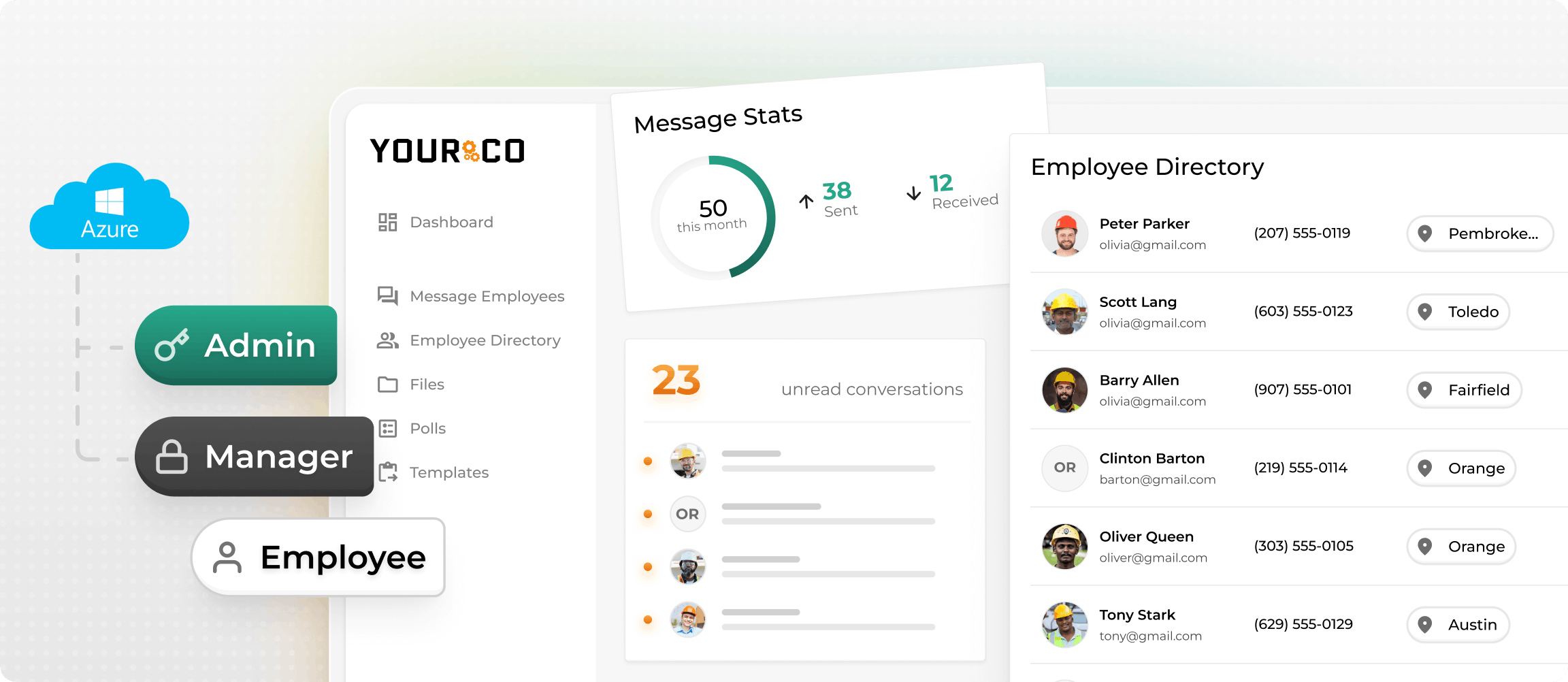
A connected worker platform tends to deliver the most value when every employee can reliably receive the information it generates, and that is the foundational blind spot many rollouts overlook. Yourco helps close that blind spot through SMS, a channel frontline employees already know how to use, regardless of device type, internet access, or technical literacy.
Yourco's core capabilities for frontline communication include:
- SMS to any phone, with no app download or Wi-Fi required, including basic flip phones
- Two-way messaging between frontline employees and managers
- AI-powered translation across 135+ languages and dialects
Yourco integrates with 240+ HRIS and payroll systems via open API, keeping employee data in sync across locations.
Enterprise Bridge enables corporate leadership to send centralized, one-way policy updates, safety directives, and company announcements across all locations, while local managers maintain direct communication with their teams.
Frontline Intelligence gives HR and operations teams centralized visibility into communication patterns, engagement trends, and operational follow-up needs across all locations. It surfaces AI-powered insights on call-off activity, attendance patterns, and sentiment trends by site or department and delivers queryable reports for leaders.
"Yourco has allowed us to scale frontline employee communications through rapid growth of the organization, while driving increased levels of engagement, employee retention, and productivity. We use it daily for HR and operational communications at the local level, and for organization-wide communications and frontline employee data analysis at the corporate level. The ease of use and implementation has driven full adoption across our workforce, becoming our most effective frontline employee communication channel."
— Madison Farrell, Director of Culture and Internal Communications, Great Day Improvements
After 90 days on Yourco, companies see two-way employee engagement reach 86%.
Try Yourco for free today, or schedule a demo to see the difference the right workplace communication solution can make for your company.
Frequently Asked Questions About Connected Worker Platforms
What is a connected worker platform?
A connected worker platform provides frontline employees with real-time access to operational data, digital work instructions, safety tools, and expert support as they perform their jobs. These platforms are typically built for mobile-first environments where workers lack desk access or a company email.
How does a connected worker platform reduce onboarding time?
These platforms can deliver training at the point of work, during the actual task, rather than in a classroom days beforehand. Digital work instructions guide new hires step by step, and AI-powered tools can help calibrate guidance to each worker's skill level.
What should HR leaders look for when evaluating connected worker platforms?
HR leaders should prioritize mobile usability, offline capability, integration with existing enterprise systems (ERP, HRIS, CMMS), safety compliance documentation, and skills tracking tied to staffing decisions. Pilot with one site and one high-value use case before scaling.
How do connected worker platforms improve safety compliance?
Many platforms digitize hazard reporting, automate incident escalation workflows, track certifications, and generate audit-ready documentation. Workers can report near-misses from a mobile device in real time, and managers can receive alerts before credentials expire, though the platform alone does not guarantee compliance.
Can frontline workers without smartphones use connected worker platforms?
Many app-based connected worker platforms require smartphones, which can exclude part of the workforce. SMS-based platforms like Yourco work on any mobile phone, including basic flip phones, with no app download, internet connection, or technical training required.
How does real-time data access benefit operations managers?
Operations managers can gain live visibility into machine status, production metrics, and work order progress without relying on phone calls or paper reports. Technicians and operators can act on actual conditions rather than scheduled cycles, which may reduce unplanned downtime and speed up decision-making on the floor.