
Gallup estimates the global disengagement cost at $8.8 trillion. If you manage frontline workers in manufacturing, logistics, retail, or hospitality, you already know the root cause: your people don't have company emails, desktop access, or time to open another app, so traditional engagement tools never reach them. This guide walks you through automating employee insights for frontline workers, step by step, so you can replace guesswork with real-time data that actually drives action.
TL;DR
- Traditional engagement surveys and app-based tools structurally exclude frontline workers who lack corporate email, computers, or reliable internet access
- Automated post-shift pulse surveys, delivered via SMS, remove the access barrier and capture feedback while the experience is fresh
- AI-powered sentiment analysis can combine text feedback with behavioral data to surface turnover risks before employees hand in their notice
- Closed-loop systems that visibly connect employee feedback to concrete action are what sustain participation over time, not more frequent surveys
- Privacy-first rollouts that lead with employee benefits and use aggregate-level tracking build the trust that makes honest feedback possible
- SMS-based platforms like Yourco enable two-way conversational feedback with any frontline worker on any phone, with no app download required
Understand Why Traditional Feedback Tools Miss Frontline Workers
The infrastructure gap is the root cause. Traditional engagement platforms assume every employee has a corporate email address, a desktop or laptop, and access to a company intranet during work hours. Frontline workers in warehouses, retail floors, kitchens, and distribution centers typically have none of these. A Yourco-commissioned survey of 150 HR leaders found that nearly two-thirds say it is significantly harder to reach frontline workers than desk-based employees.
The consequences are structural, not incidental. When a survey platform sends a link to an email address a warehouse associate has never opened, the response rate is zero. When an HR app requires a Wi-Fi connection to load, workers on a distribution floor or a construction site cannot access it. The data that reaches leadership reflects only the office-based minority, so decisions about scheduling, safety, and engagement are built on a fundamentally incomplete picture of the workforce.
This gap also compounds over time. Frontline workers who never receive surveys stop expecting to be asked. Disengagement becomes invisible to leadership precisely because the tools designed to surface it cannot reach the people experiencing it.
The channel that reliably reaches every worker already exists in their pocket. The question is whether your feedback system is built around it.
Adopt Mobile-First, No-App Channels for Data Collection
SMS is the only channel that passes the "no app, no email, no computer" test for frontline accessibility. The structural case is straightforward: Workers without corporate email or assigned devices are never reached by traditional survey tools, creating a 0% invitation rate. This entirely excludes up to 80% of the workforce from standard engagement metrics. When you choose your data collection channel, prioritize these requirements:
- No app download required, so adoption isn't gated by device type or storage space
- Works on any mobile phone, including basic and prepaid devices, which are common among hourly workers
- Multilingual delivery for workforces where English isn't every employee's primary language
- Zero cost to employees, so participation doesn't create a financial barrier
- Two-way capability so workers can respond, ask clarifying questions, or share context beyond a numeric rating
This removes every adoption barrier in one move: employees receive an SMS and reply to it.
Automate Post-Shift Pulse Surveys Workers Actually Answer
The survey framework classifies post-shift surveys as event-based pulses, designed to capture situational, real-time insights rather than to replicate annual engagement instruments. For SMS delivery at shift end, keep surveys to a short format.
Design your surveys in layers for maximum signal with minimum friction:
- Layer 1 (always included): A single quantitative anchor question that produces trendable data, such as “On a scale of 1–5, how would you rate your shift today?”
- Layer 2 (rotating weekly): A driver question cycling across safety, recognition, workload, tools, and scheduling to build a broader diagnostic picture over time.
- Layer 3 (conditional only): An open-text follow-up triggered only by a low score on Layer 1, keeping friction low for satisfied workers while capturing detail from those who need to be heard.
Send surveys post-shift, ideally within 30 minutes of clock-out. Start with a monthly cadence and increase the frequency only when managers can confirm their capacity to review and respond to results. The practical rule is simple: survey only as fast as you can act.
Use AI Sentiment Analysis to Spot Turnover Risks Early
AI-powered sentiment analysis classifies text from survey responses and employee channels, enabling emotional signals to be tracked over time. It can also help surface recurring themes like workload, leadership quality, or safety concerns.
The real accuracy gains come from combining text signals with behavioral HR data. A 2025 review found that multimodal models integrating survey text with numerical data, such as attendance patterns, tenure, and role changes, outperformed single-modality approaches in predicting employee attrition. For frontline operations, this means the system can flag a warehouse team showing declining sentiment alongside rising absenteeism before a spike in voluntary turnover.
A retention analysis shows how time and attendance records reveal hidden patterns where absenteeism, consecutive long shifts, or frequent shift changes correlate with subsequent turnover, enabling managers to receive more tailored retention recommendations.
The critical safeguard: AI predictions must always include human review before any action. A model that incorrectly flags an employee as a flight risk can trigger managerial behavior that pushes the employee out, creating a self-fulfilling prophecy.
Close the Loop With Visible Action That Sustains Participation
What most organizations call "survey fatigue" is often fatigue from the absence of action. Gallup estimates that a large share of employee turnover is preventable but goes unaddressed, making the Act and Close stages of any feedback system the highest-leverage intervention points. The stakes are real: the same Yourco-commissioned survey of 150 HR leaders found that 88% believe better communication tools can directly reduce employee churn.
Effective closed-loop systems operate on three action types:
- Auto-recognition: When survey data or sentiment signals identify a high-performing team or shift, trigger immediate acknowledgment.
- Workflow fixes: Use aggregated feedback to identify systemic issues such as scheduling bottlenecks, equipment shortages, or understaffing patterns.
- Manager nudges: When a worker's sentiment drops, prompt their manager with a specific conversation guide. Gallup found that employees whose manager holds one meaningful conversation per week are far more likely to be highly engaged.
The loop closes when employees see the connection between their feedback and a resulting change. Share actions taken using a simple "You Said, We Did" format within each survey cycle.
Build a Privacy-First Framework That Earns Employee Trust
Automated data collection only works when employees trust the system enough to provide honest feedback. Successful frontline survey programs often invest time in building trust before the first survey is sent.
Follow these trust-building principles when rolling out any automated insight system:
- Lead with employee benefits in every rollout communication: frame clock-in tracking as payroll accuracy protection, safety checks as OSHA compliance, and survey collection as the mechanism for fixing identified problems
- Use aggregate metrics for operational decisions rather than individual-level tracking that feels like surveillance
- Configure anonymity thresholds to prevent re-identification in small shift cohorts
- Give employees self-service access to their own data proactively
- Separate monitoring data from human-reviewed discipline in any adverse action
- Communicate what is not collected as explicitly as what is, including off-clock location and personal device activity
When employees see that the system protects them rather than monitors them, honest feedback follows.
This information is for general awareness only. For specific compliance guidance, consult with qualified legal professionals.
Track the Metrics That Drive Real Outcomes
Your dashboard should surface signals that connect directly to retention, safety, and operational performance. Industry benchmarks provide participation targets for frontline environments, and participation benchmarks can help you spot a program design or trust problem early.
Build your dashboard around these core metric categories:
- Survey participation rate as a leading indicator of program health and employee trust
- Sentiment trend by location and department to detect emerging hotspots before they become turnover events
- Recognition frequency per employee per month, given that recognition gaps remain common
- Absenteeism and overtime hours as real-time burnout signals
- Feedback-to-action cycle time measures how quickly your organization converts insights into visible changes
People analytics research shows that organizations with the highest people analytics maturity are more likely to exceed financial targets, reinforcing the principle that data from HR, payroll, and workforce management must reside in a single, unified view to make operational risk visible.
Integrate Insights Seamlessly Into Daily Operations
Tracking metrics is only half the job. The other half is making sure those insights reach the people who can act on them, fast enough to matter.
- Route alerts to the right managers: When sentiment or shift satisfaction drops below baseline for a specific team, automated notifications deliver that signal directly to the responsible supervisor before it surfaces in a weekly report.
- Connect data to existing workflows: Sync survey results and attendance trends with workforce scheduling and safety audits so operational leaders can adjust staffing, check-ins, or protocols without switching between platforms.
- Align HR, operations, and safety teams: Shared dashboards give every department a common view of location-level trends, so decisions on shift coverage, burnout risk, or compliance gaps draw from the same source of truth.
A logistics team, for example, could automatically flag low night-shift sentiment scores for a supervisor to check in the following day, turning a passive data point into a timely operational response.
Turn Frontline Feedback Into Actionable Intelligence With Yourco
Yourco gives HR directors, operations leads, and frontline managers a single platform purpose-built to capture, analyze, and act on employee insights from every worker, on any device, at every location.
Core communication capabilities:
- SMS-based delivery to any phone with no app download, no Wi-Fi, and no cost to employees
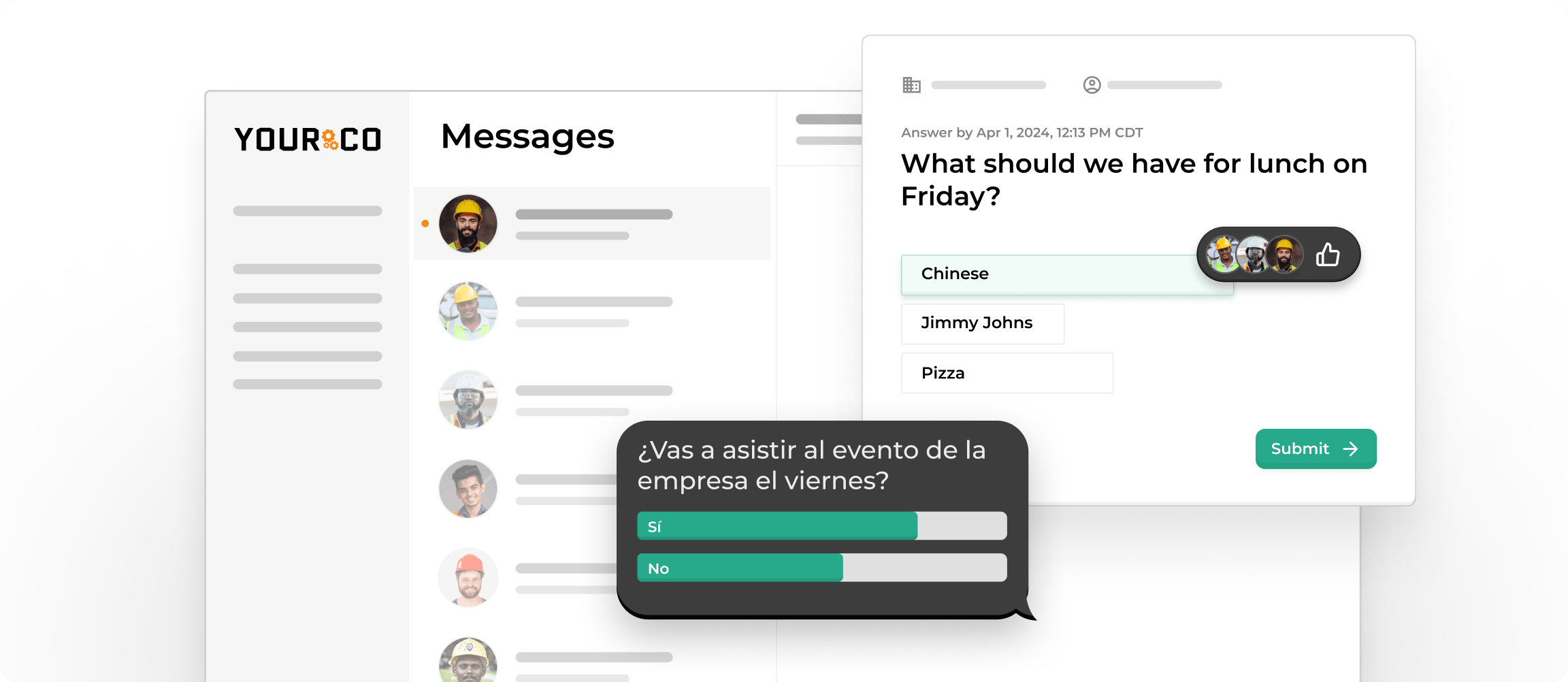
- Two-way messaging that enables real-time conversational feedback between workers and managers
- AI-powered translation across 135+ languages and dialects, so employees can respond in their preferred language
- 240+ HRIS and payroll system integrations to automatically sync employee rosters, language preferences, and role data
- Enterprise Bridge enables corporate leadership to broadcast one-way announcements, policy updates, and survey results to every frontline location simultaneously, while local managers maintain direct communication with their teams
- Frontline Intelligence gives HR, leadership, and operations teams centralized visibility into survey responses, poll results, and daily communication patterns across all locations, helping leadership identify sentiment trends, spot retention risks early, and make proactive decisions by location, department, or shift
"We have nearly 700 employees and 80% are non-desk based, communication is a challenge. Yourco provides a quick easy way to reach everyone and a secure way for employees to reach HR and leadership without a computer."
— Felisha Parker, VP Human Resources, McCarthy Auto Group
After 90 days on Yourco, companies see two-way employee engagement reach 86%.
Try Yourco for free today, or schedule a demo to see the difference the right workplace communication solution can make for your company.
Frequently Asked Questions About Automated Employee Insights For Non-Desk Teams
How do you collect employee feedback from frontline workers without an app?
SMS-based platforms like Yourco deliver pulse surveys and two-way messages directly to any mobile phone, including basic flip phones. Employees can respond via SMS with no downloads, logins, or internet connection required.
How many questions should a post-shift pulse survey include?
Keep a post-shift pulse survey very short. Start with one rating question, rotate a driver question when needed, and use open-text prompts only as follow-up questions when a response suggests more context is needed.
What is a closed-loop employee feedback system?
A closed-loop system captures employee feedback, analyzes it for patterns, triggers a concrete response such as recognition or a workflow fix, and then communicates back to employees what changed and why. The loop is only closed when workers can see the connection between their input and a resulting action.
How does AI sentiment analysis predict employee turnover?
AI sentiment analysis classifies text from survey responses and communications, then combines these signals with behavioral data such as attendance patterns and tenure to generate flight-risk scores. It works best when text and operational data are reviewed together, and managers apply human judgment before acting.
How do you avoid making frontline monitoring feel like micromanagement?
Lead with employee benefits in every rollout communication, use aggregate-level metrics for operational decisions rather than individual tracking, and clearly communicate what is not being collected. Building trust before the first data point is captured is a precondition for honest feedback.
What survey participation rates should frontline programs target?
Target strong, consistent participation that reflects trust in the process. If participation remains low, it usually indicates a problem with channel, design, timing, or follow-through rather than a lack of employee interest in providing feedback.