
3.2% is the 2024 national absence rate for full-time U.S. wage and salary workers, according to federal labor data. An HR leader at a manufacturing plant who looks up a national absenteeism benchmark may overreact or relax based on that single number. Frontline sectors pull the blended average upward while management and professional roles pull it downward, so the number tells a frontline-heavy operation little on its own. Industry and occupation breakouts give leaders a closer like-for-like comparison.
TL;DR
- The national average blends every industry into one figure, so benchmark against your own industry and occupation mix.
- Match the formula to the benchmark, because government and organizational formulas answer different questions.
- Frontline-heavy sectors run at structurally higher levels, driven more by physical demands and occupation mix than by management quality.
- Check schedule stability and call-off reporting before reading a benchmark as a verdict.
- A benchmark is only as accurate as the reporting behind it, and voicemail or relay systems distort it either way.
- SMS-based platforms like Yourco capture reliable call-off data to build an accurate baseline for absenteeism.
Start With the Correct Absenteeism Rate Benchmarks
According to federal labor data, the 2024 annual average absence rate for full-time wage and salary workers in the United States was about 3.2%, with roughly 2.0–2.1% due to illness or injury and about 1.1–1.2% for other reasons. The separate lost worktime rate, which measures hours absent as a percent of hours usually worked, is 1.7%.
Federal labor methodology defines absences as instances when full-time workers, those usually working 35 or more hours per week, worked fewer than 35 hours for qualifying reasons: own illness or injury, child care problems, other family or personal obligations, civic or military duty, and maternity or paternity leave. The methodology excludes vacation, personal days, holidays, and labor disputes. Those boundaries define the benchmark that any internal benchmark should match.
Calculate Absenteeism Rate the Same Way You Benchmark It
Government methodology and organizational methodology coexist, and mixing them produces numbers that leaders cannot compare. Leaders benchmarking against government data need to align their internal formulas with the Bureau of Labor Statistics' approach, or accept that the comparison is invalid.
Absenteeism formulas differ by numerator and denominator:
The organizational method counts scheduled workdays as open business days minus observed holidays, so a company open five days a week that closes for 10 holidays would use 250 days. The government rate measures the prevalence of workers with any absence. The organizational rate measures the daily volume and the share of scheduled days lost. Leaders can use both, but they answer different questions and produce different numbers for the same workforce.
Read the Benchmark by Industry, Not by Blended Average
The single national average sits near the midpoint of a wide range, and frontline workforce composition heavily influences it. Using it as a universal benchmark makes frontline-heavy operations look like underperformers and makes desk-heavy organizations look normal when their rates are lower by composition. According to 2024 federal data, occupation rates range from 2.3% for management to 4.3% for healthcare support, a two-percentage-point spread.
The 2024 federal table shows these industry and occupation absence rates for frontline-heavy employers:
Office and administrative support, at 3.9%, runs above the national average and well above management occupations at 2.3%. The desk-versus-frontline split maps imperfectly onto white-collar versus blue-collar. The cleaner comparison separates management and professional work from service and caregiving-heavy roles.
Understand Frontline Absence Drivers
Healthcare support occupations run well above the national average, and physical and caregiving demands help explain the higher rate. Federal injury data show that health care and social assistance carry a large injury and illness case burden, which helps explain the sector's elevated absence rate.
Several mechanisms explain why a blended average systematically understates frontline sector absence:
- Physical demands and injury risk raise musculoskeletal and fatigue-related absence in intensive roles
- Frontline roles cannot substitute remote work for a formal absence, while managers can sometimes keep working through minor illness
- Service occupations in the federal table, including food preparation and serving, run above the national average
- Caregiving obligations weigh heaviest on the female 25-to-54 demographic that predominates in healthcare support roles
These drivers mean that a manufacturer benchmarking at 2.8% and a healthcare system benchmarking at 3.8% are both operating within normal ranges for their sectors, despite the one-point difference.

Separate Top-Quartile From Typical in Frontline Operations
Within a given frontline sector, leaders should check operational conditions before treating absenteeism rate benchmarks as a performance verdict. The checks below help leaders determine whether a location is typical for its sector or is showing signs of preventable absence.
Schedule stability affects shift-worker output. A 2024 University of Texas study distinguishes schedule consistency from predictability and finds that day-of-week and hour-of-day consistency improve shift-worker productivity.
Workplace research links weekly manager contact with higher engagement across role types: when a manager has one meaningful conversation a week with each direct report, employees are four times as likely to be highly engaged, according to Gallup engagement research.
Reporting reliability shapes the benchmark itself. If call-off reporting is handled via voicemail or supervisor relay, leaders should validate the reported data against payroll or attendance records before treating the reported rate as final.
A frontline absence rate slightly above the national average may be normal for the sector. A rate that stays high after leaders improve scheduling practices, increase manager contact, and reconcile call-off records deserves closer review.
Turn Reporting Into a Benchmark You Can Trust
Leaders can trust a benchmark only when they trust the data feeding it, and frontline reporting is where accuracy most often falls short. How workers report absences shapes the number itself: administrative records tend to be more complete, whereas self-reported methods suffer from recall gaps and low response rates. Because collection methods affect the absence rate, leaders need to know how workers report absences before they compare numbers.
Frontline reporting falls short, in part, because the channel does not reach workers. A Yourco-commissioned survey of 150 HR leaders connected missed messages and updates that never reach frontline workers with business risk across productivity, retention, safety, absenteeism, and benefits participation.
For organizations where frontline workers lack company email or desk access, SMS-based platforms like Yourco give workers a simple, documented way to text off, capturing call-offs with timestamps rather than losing them.
Because self-report and administrative methods can diverge, frontline sectors face distortion in both directions, and leaders should watch for each:
- Overstatement: fragmented systems can count protected leave alongside unexcused no-shows in a single inflated number
- Understatement: voicemail and relay systems can produce an artificially low rate when leaders do not reconcile them against attendance records
Both distortions undermine comparability, so leaders need a reliable reporting channel before comparing their rate to an external benchmark.
Build an Accurate Absenteeism Baseline With Yourco
Reliable benchmarking starts with reliable data capture, and that starts with reaching every frontline worker on the device they already carry. Yourco is an SMS-based employee communication platform built for organizations where most of the workforce does not sit at a desk. Leaders get a documented, real-time record of call-offs and text-offs to benchmark from.
Yourco's capabilities match how frontline teams report absences:
- Standard SMS: reaches any phone, including basic flip phones, with no app download required
- Two-way messaging: workers report absences, send feedback, and confirm receipt
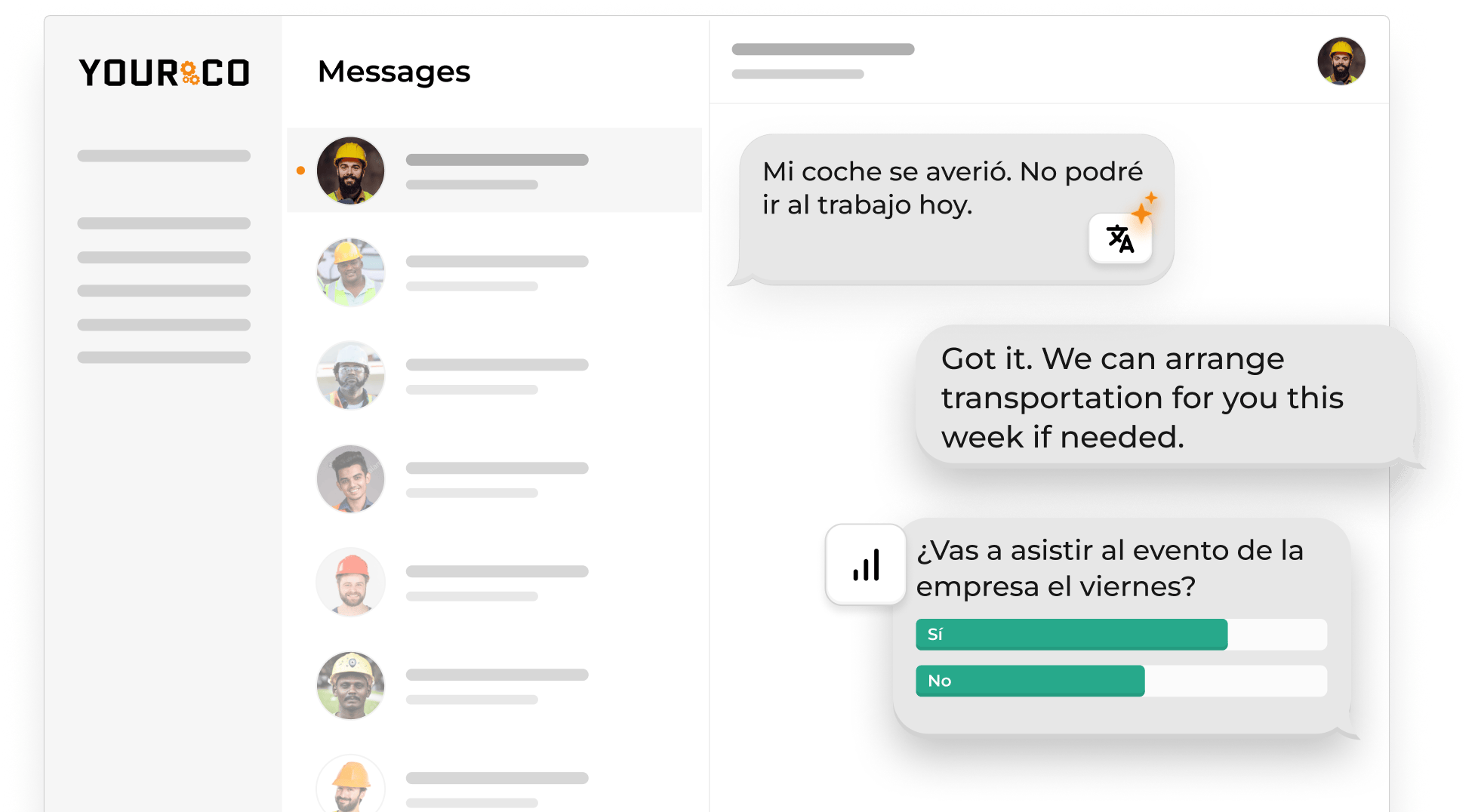
- Translation: AI-powered translation covers 135+ languages and dialects
With those capabilities, HR and operations teams capture absence information in the moment instead of reconstructing it later from voicemail, incomplete spreadsheets, or texts to supervisors.
Yourco connects to 240+ Human Resources Information Systems (HRIS) and payroll integrations, so absence data unifies with existing employee records.
Enterprise Bridge allows corporate leadership to send centralized, one-way attendance and policy updates across all locations, while local managers maintain direct communication with their teams.
The Yourco AI Call-Off Agent automates the call-off conversation over two-way SMS. When a worker texts off, the agent collects the dates and reason, asks for anything missing, confirms the request, and notifies the supervisor without HR intervention. Each confirmed call-off is logged automatically with an audit trail and flows into downloadable attendance reports.
Those records feed Frontline Intelligence, which gives HR and operations teams centralized visibility into call-off and attendance data across all locations. It generates call-off activity reporting, along with shift confirmations and response times, and helps leaders identify patterns by site or department. The absenteeism baseline they benchmark against reflects actual call-off activity, including those a phone tree would otherwise fail to capture.
"We use Yourco for our absence management and for sending out notices, reminders, and announcements to our employees. It keeps everyone who needs to know informed when people are absent."
— Kyle Stover, HR Assistant, J-Lenco Inc.
After 90 days on Yourco, companies see two-way employee engagement reach 86%.
Try Yourco for free today or schedule a demo to see how SMS-based call-off reporting captures cleaner absenteeism data.

Frequently Asked Questions About Absenteeism Rate Benchmarks
What is a good absenteeism rate by industry?
A good absenteeism rate depends on your industry and occupation mix. Manufacturing typically runs near the low end of normal, while healthcare support and food service run at structurally higher levels. Compare against your specific sector before deciding whether your rate signals a problem.
How is the absenteeism rate calculated?
The most common organizational method divides lost workdays by total scheduled workdays for a given period. The government method instead divides the number of workers with any absence by the total full-time wage and salary workers. These methods produce different numbers, so pick one and apply it consistently when benchmarking.
Why does my frontline absenteeism rate look high against the national average?
Your frontline absenteeism rate may appear high because the national average conflates lower-absence management roles with higher-absence frontline roles. Physical demands and a caregiving-heavy occupation mix can push frontline rates higher even when management practices are sound. Benchmark against your industry row instead.
How can I make my absenteeism data accurate enough to benchmark?
Accurate absenteeism data starts with a consistent reporting channel that captures every call-off with a timestamp, rather than losing it in voicemail or supervisor relay. SMS-based platforms like Yourco give frontline workers a simple way to text off and give HR a documented record. Reliable capture makes benchmark comparison meaningful.
What counts as an absence for benchmarking purposes?
Standard government definitions count absences due to illness or injury, child care problems, family or personal obligations, civic duty, and parental leave. They exclude vacation, personal days, and holidays. Matching this definition in your own tracking keeps your internal rate comparable to published benchmarks.
How do I track employee absences more efficiently?
Tracking employee absences more efficiently means capturing each call-off in one place as it happens, instead of reconstructing it later from voicemail, spreadsheets, or texts to supervisors. SMS-based platforms like Yourco log every absence report with a timestamp and automatically notify HR and the relevant supervisor, so the record stays complete and benchmark-ready.
What's the best way for employees to report an absence?
The best way for employees to report an absence is a channel reachable instantly from any phone, with no app, email, or login required. A text message works on any device, including basic flip phones, and creates a documented, timestamped record. Yourco gives frontline workers a simple line to text off.