
When the grid fails, it does not just shut off the lights. It kills your Wi-Fi, silences your VoIP phones, disables badge-access doors, and starts draining the backup batteries on the cell towers your entire workforce depends on. If your emergency action plan assumes everyone can pull out a smartphone and check an app, a regional outage will expose that gap fast, and delayed evacuations cost lives. This guide walks through every backup communication layer available to frontline safety teams and explains how to build a system that keeps working when nothing else does.
TL;DR
- Power outages trigger a cascade that kills Wi-Fi, VoIP, and eventually cell service, stripping away digital communication layers your team depends on.
- NOAA weather radios provide infrastructure-independent incoming alerts but cannot send messages back.
- GMRS two-way radios enable supervisors to coordinate in real time without relying on any external network.
- Mesh networking devices can extend communication coverage for days during longer outages.
- A layered backup plan that combines radios, charging options, paper contact lists, and vehicle power keeps your team connected during extended outages.
- SMS-based platforms like Yourco reach every worker's existing phone in the critical early hours before towers fail, giving your first layer of emergency alerting the widest possible reach.
Understand Why Power Outages Sever Safety Communication
A power outage does not affect one system. It triggers a cascade that strips away communication layers in sequence.
First, building power fails. That takes out Wi-Fi routers, VoIP desk phones, intercoms, electronic access systems, and any cloud-based platform your teams rely on. Within hours, the cell towers serving your area start running on backup batteries. According to FCC reporting, county-level cell tower outages during major weather events have reached as high as 33.3% of towers in affected areas.
Major weather-related grid outages can last well beyond 24 hours, far longer than most backup systems are designed for. NFPA 72 requires only 24 hours of standby power for fire alarm systems, and FCC guidelines require only 8 hours of backup for IP-based voice services. Those planning baselines do not fully match longer outage conditions.
What remains functional during an extended outage? GMRS radios with fresh batteries. NOAA weather receivers with hand-crank power. Mesh networks with solar panels. Everything else requires advance planning to survive.
The safety stakes are real. NIST research confirms that depriving workers of information during emergencies leads to delayed responses, misinterpreted threats, and ignored evacuation routes. For frontline teams across manufacturing, healthcare, and logistics, a communication blackout during an emergency is a direct threat to life safety.
Keep Traditional Landlines in Perspective
Traditional copper landlines (POTS) earned their reputation as outage-proof communication because they drew power directly from the telephone company's central office. That era is ending. As of 2024, only about 25.5% of wireline residential voice connections still run over true copper infrastructure, and major carriers have filed retirement notices in multiple states, targeting full copper network retirement by carrier-specified timelines.
Most "landlines" installed in recent years are actually VoIP or wireless-based services that depend on the same power and internet infrastructure that fails during outages. Many employers use OSHA 29 CFR 1910.38 and 1910.165 as a planning baseline for emergency reporting and alert systems. Do not build your backup communication plan around copper landlines alone.
This information is for general awareness only. For specific compliance guidance, consult with qualified legal professionals.
Deploy NOAA Weather Radios for Incoming Alerts
NOAA Weather Radio All Hazards runs continuously, independent of commercial power, cellular networks, and internet infrastructure. The network is operated by the National Weather Service and broadcasts emergency alerts across 95% of the U.S. population through more than 1,000 transmitters.
When deploying NOAA radios, follow these practices:
- Place at least one SAME-enabled radio at every continuously staffed control point: security desks, plant manager stations, and operations centers. Program your facility's specific FIPS county code to eliminate alert fatigue.
- Choose units with battery backup, plus solar and hand-crank charging options for extended outages.
- In noisy environments, add strobe lights and visual alert accessories to ensure staff wearing hearing protection receive warnings.
The critical limitation is that NOAA radios are receive-only. They must be paired with two-way communication systems for coordination and evacuation.

Equip Teams With Two-Way Radios for Real-Time Coordination
Two-way radios require zero infrastructure. No towers, no internet, no building power. For most facilities, GMRS offers the best balance of capability and simplicity:
Deploy GMRS radios to every shift supervisor, security desk, and plant manager station. For large facilities, install a GMRS repeater to eliminate dead zones. Plan battery redundancy in three tiers: high-capacity rechargeables providing up to 30 hours of operation; non-rechargeable emergency batteries with a 10-year shelf life; and vehicle-based charging via 12V DC adapters for sustained operation during longer outages.
This information is for general awareness only. For specific compliance guidance around radio licensing for commercial employee use, consult with qualified legal professionals or an FCC-licensed frequency coordinator.
Extend Coverage With Mesh Networks, Satellite, and SMS
When cell towers start failing during an extended outage, three technologies fill the gap. Mesh networks use LoRa radio technology, where each device acts as both a communicator and a signal repeater, extending coverage several kilometers per hop without cell or internet infrastructure, with battery autonomy of 72+ hours on a solar mesh setup.
Satellite messengers work when all terrestrial infrastructure fails. Devices with direct-to-device satellite capability allow SMS-based communication independent of cell towers, Wi-Fi, and grid power. The trade-off is low bandwidth, higher latency, and subscription costs, making satellite a last-resort layer rather than a primary coordination tool.
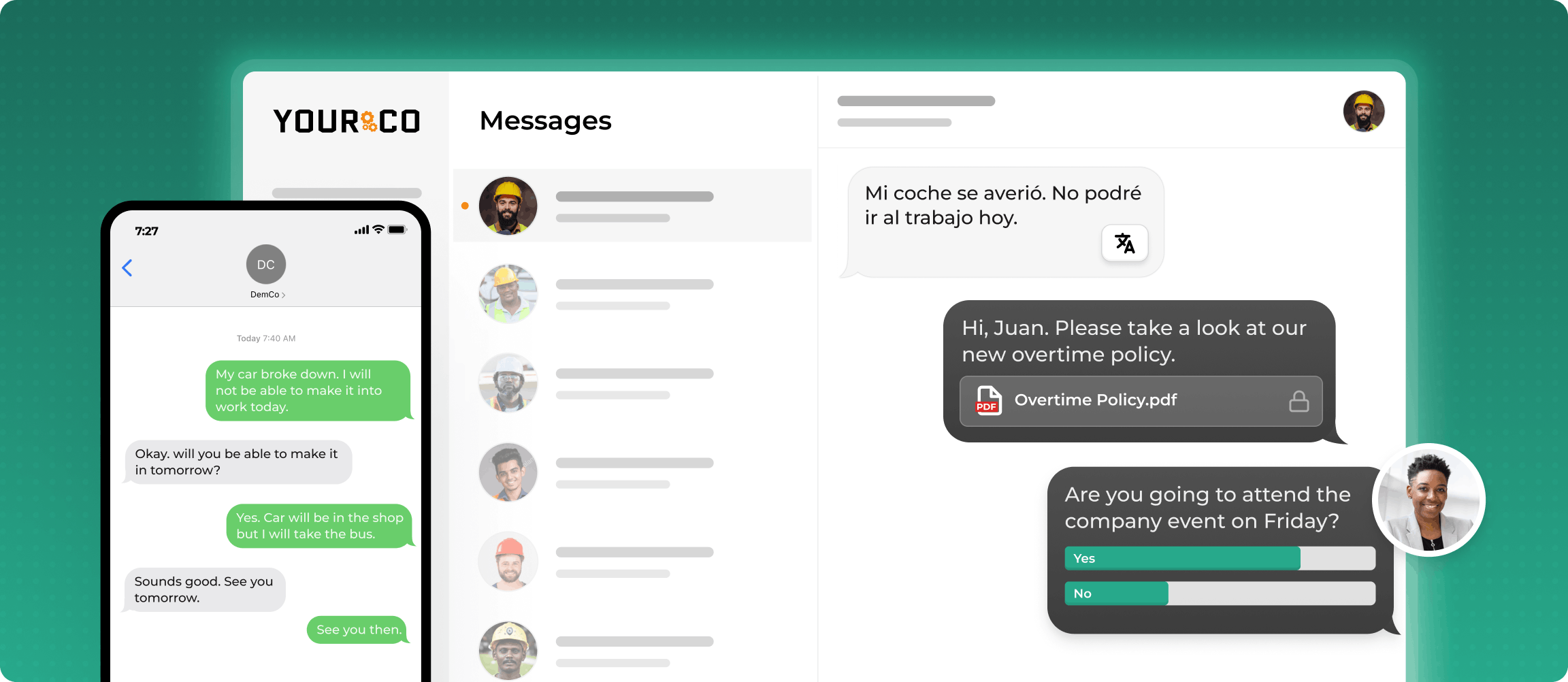
SMS reaches every worker's phone instantly, as long as the cellular infrastructure is still functional. It uses less bandwidth than voice or data, making it more resilient during network congestion. The importance of this layer is supported by data: a Yourco-commissioned survey of 150 HR leaders found that 93% believe clear safety communication reduces workplace incidents.
The optimal layering:
- Early outage: SMS to the entire workforce
- Through the outage: GMRS radios for supervisor-level coordination
- Continuous: NOAA weather radio at all control points
- Longer outages: Mesh network if cellular degrades; satellite messengers for critical leadership communication
This layered approach ensures no single point of failure leaves your team without a way to communicate.
Build Your Backup Communication Checklist
Many employers use OSHA 29 CFR 1910.165 as a planning baseline for backup communication and alarm readiness. FEMA continuity guidance provides additional frameworks for facilities seeking to develop more formal emergency response plans. Essential steps:
- Procure power banks for all frontline supervisors and safety managers.
- Install 12V DC-to-USB-C adapters in all company vehicles designated for emergency response.
- Deploy GMRS radios to every shift supervisor and security desk.
- Place SAME-enabled NOAA weather radios at every continuously staffed control point.
- Create laminated paper contact lists, including an out-of-state relay contact, and post at the main office, break room, security desk, and each supervisor's station.
- Update your written action plan to include power outage response steps, generator startup procedures, and communication fallback sequences.
- Test backup communication systems quarterly, including interoperability between radio, SMS, and NOAA systems.
- Review the Emergency Action Plan with every new employee upon hire and with all employees whenever the plan changes.
Run through this list quarterly and after every major facility change to keep your backup systems up to date.
This checklist is for general planning purposes. Consult with qualified safety and legal professionals to ensure compliance with OSHA, FEMA, and local regulations applicable to your facility.
Reach Every Frontline Worker Instantly With Yourco
Every backup communication system in this article addresses a specific failure window. But the first and broadest layer is the one that reaches every worker's existing phone in the opening minutes of a crisis, before towers fail and before radios can be distributed.
Yourco is an SMS-based employee communication platform built specifically for frontline workers:
- SMS to any phone: Emergency alerts reach smartphones and basic flip phones alike. No app download, no Wi-Fi, no data plan required.
- Two-way messaging: Workers can reply to confirm safety, report hazards, or attach photos of incidents in real time.
- AI-powered translation: Messages are composed once and delivered in each worker's preferred language across 135+ languages and dialects, eliminating translation delays that put multilingual teams at risk during evacuations.
Yourco integrates with 240+ HRIS and payroll systems, keeping employee contact data synced automatically so emergency rosters are never stale when a crisis hits.
Enterprise Bridge enables corporate leadership to broadcast emergency alerts and safety updates to every frontline location simultaneously, keeping all sites aligned during regional events.
Frontline Intelligence analyzes real-time communications and employee feedback to spot risk patterns before incidents happen, track which locations report the most safety concerns, and monitor how quickly workers acknowledge critical alerts. Leadership gains visibility into frontline workforce response during emergencies, enabling teams to act on emerging issues before they escalate.
"Yourco has been huge for us, especially during the weather crisis. We were able to keep our employees safe and make sure everyone was notified of updates in a timely manner."
— Scott Pfantz, Operations Manager, Nufarm - Alsip
After 90 days with Yourco, two-way employee engagement increased to 86%. When every second counts during a power outage, that level of engagement means your workforce is already conditioned to read and respond to the messages that matter most.
Try Yourco for free today, or schedule a demo to see the difference the right workplace communication solution can make for your company.

Frequently Asked Questions About Safety Communication During Power Outages
What communication systems work when cell towers go down?
GMRS and FRS radios, NOAA weather radios, satellite messengers, and mesh networks can still work when cell towers are down. A layered plan gives you both incoming alerts and two-way coordination.
How long should backup communication equipment last during a power outage?
Plan for at least 72 hours. Major outages tied to severe weather or infrastructure damage frequently extend beyond a single day. The most reliable approach combines high-capacity rechargeable batteries, non-rechargeable backups with long shelf lives, and paper contact methods so no single failure point leaves your team unreachable.
Does OSHA require backup communication during power outages?
Many employers use OSHA alarm and emergency action plan standards as a baseline when planning for outages. This information is for general awareness only. For specific compliance guidance, consult with qualified legal professionals.
How do you send emergency alerts to workers without smartphones or Wi-Fi?
SMS-based platforms like Yourco can send alerts to any mobile phone, including basic flip phones, without an app or Wi-Fi. If cellular service is unavailable, radios provide a separate backup option.
How do you create an emergency communication plan for a power outage?
Start by mapping every communication tool your facility currently uses, then identify which ones fail when the power goes out. From there, assign a backup for each failure point: radios for coordination, NOAA receivers for incoming alerts, and SMS for initial workforce-wide notification. Document the fallback sequence, assign ownership to specific roles, and test it quarterly.