
Most frontline performance problems are invisible until they're expensive. A picker running at 60% throughput, a technician with a rising call-back rate, a site where absences cluster on Mondays, none of it shows up in a quarterly review until the cost has already landed. For manufacturing, logistics, and field service managers, the window to fix a performance issue is the shift it starts, not the month it gets reported.
TL;DR
- Frontline performance tracking combines productivity calculation with compliance and engagement signals for frontline teams. It replaces the slow, biased feedback of annual reviews.
- The KPIs that matter most include time-to-productivity, task completion, quality scores, safety and compliance adherence, attendance, customer or job-site satisfaction, and training completion.
- Low-friction, mobile-first tools let workers report from the field without stopping work. Managers get real-time visibility across every location.
- Frequent check-ins and two-way communication correct problems early, reinforce good work, and reduce the burnout that drives turnover.
- Use on-the-job execution and operational outcomes to evaluate training.
- SMS-based platforms like Yourco turn frontline communication into measurable performance data without requiring an app, password, or Wi-Fi.
Understand What Frontline Performance Tracking Really Means
Frontline performance tracking continuously measures productivity, compliance, and engagement for workers who operate on the floor, in the warehouse, on the road, or at the job site. Instead of a single annual snapshot, it pulls real-time signals from daily operations, enabling managers to act while a problem is still small. For distributed teams that don't sit at desks, this approach means catching an issue during a shift rather than in a quarter.
Annual reviews fail frontline teams for clear reasons; a 12-month lag means safety or throughput problems persist for months before formal review, and generic ratings rarely capture the specific work people actually do. Newer performance-management guidance also favors ongoing feedback over once-a-year cycles.
Fragmented HR systems scatter workforce data across tools and locations, and when frontline employees have limited access to corporate communication systems, the old model moves slowly and leaves people disconnected from the feedback that keeps them on track.
Track the Metrics That Actually Move Operations
The right metrics give managers and workers something specific enough to act on. Clear KPIs tied to daily work help a machine operator or delivery driver improve. Focus on measures tied to safety and output while keeping retention signals visible.
Here are the core KPIs frontline managers should track across distributed teams:
- Time-to-productivity: How long until a new hire reaches full output?
- Task completion and throughput: Orders picked per shift, units processed and tickets resolved.
- Quality scores: Overall Equipment Effectiveness (OEE) in manufacturing and first-time fix rate in field service.
- Safety and compliance adherence: Total Recordable Incident Rate (TRIR) and Days Away, Restricted, or Transferred (DART) rates, plus acknowledgment of safety directives.
- Attendance tracking: Present shifts divided by planned shifts, a leading signal of coverage risk and burnout.
- Customer or job-site satisfaction: Customer Satisfaction Score (CSAT) and job-window adherence in field service.
- Training completion: Tracked against on-the-job results alongside course sign-off.
Pick the handful that map to your operational goals, then measure them consistently across every site so you can compare and spot patterns.
This information is for general awareness only. For specific compliance guidance, consult with qualified legal professionals.
Build a Practical, Low-Friction Tracking System
A tracking system only works if workers can use it without stopping their work. Email sits unread for hours, and apps that require downloads, passwords, and Wi-Fi quietly exclude part of your workforce. Meet workers on the one tool they already carry: SMS.
SMS is the lowest-friction capture method because it requires no app and no reliable internet connection. It works on any phone, including basic and flip phones, and collects shift confirmations, overtime responses, absence reports, and quick pulse answers via simple two-way text messages with timestamped records. SMS-based platforms like Yourco are designed for exactly this, reaching every worker on any device and turning responses into timestamped operational data.
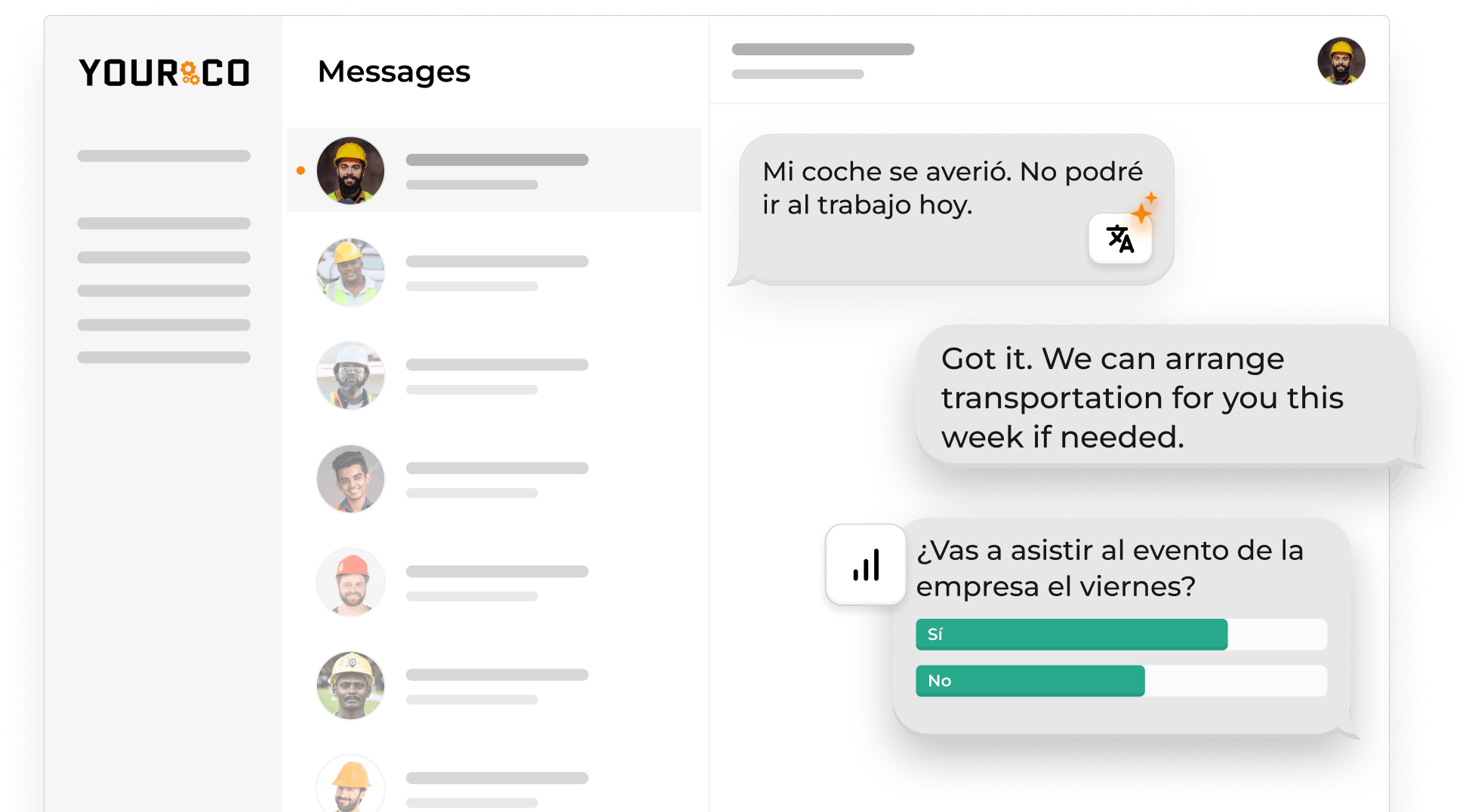
To keep updates from interrupting work, align check-ins with natural breaks or shift changes, and keep questions operationally specific, such as "Did you have enough information to run the new line?" That kind of two-way communication gives managers real-time visibility while respecting the pace of the floor.
Two patterns show how this works in practice:
- Logistics: A warehouse lead texts a one-tap shift confirmation each morning. Immediate replies flag coverage shortfalls before pick rates fall.
- Manufacturing: A plant collects end-of-shift defect notes by SMS so the next shift starts informed rather than catching up.
In both cases, capturing data where the work happens produces the fastest and most accurate picture.
Turn Frontline Feedback Into Action
Tracking only matters if it changes what happens next. Frequent, two-way conversations let you correct issues early, reinforce good work while it's fresh, and catch the workload strain that leads to burnout. 85% of HR leaders say their frontline employees express frustration with how they communicate with their managers, according to a Yourco-commissioned survey of 150 HR leaders, indicating that feedback quality is already a live pain point before any tracking system is introduced.
Better supervisor communication is consistently associated with lower burnout rates in frontline settings. In manufacturing, recent guidance frames authentic, two-way communication as a key advantage in retaining skilled workers. Use these practices to keep feedback flowing without adding meetings:
- Run short weekly check-ins focused on wins and roadblocks, including what support people need.
- Use specific, timely feedback: describe the situation, behavior, and impact so it is fair and actionable.
- Ask a simple workload prompt, such as "Is anything feeling unmanageable right now?"
- Recognize strong performance immediately, since people remember recent experiences best.
- Close the loop by telling teams what you heard and what's changing.
When workers see that responding changes something, participation rises, and small problems get solved before they escalate.
Tie Training to On-the-Job Execution and Outcomes
Course completion only shows whether someone clicked through a module. On-the-job behavior shows whether they can do the job better. Move away from course completion rates and connect training to concrete business outcomes. Connect learning to what happens on the floor.
For training evaluation, look at behavior, specifically whether people apply the skill on the job, and results: safety, quality, or output. Define the operational target first, identify the specific behaviors that drive it, and plan reinforcement so the training sticks. SHRM points to practical training-linked KPIs worth tracking: time-to-competency, knowledge retention, task execution accuracy, and manager confidence scores.
- Field service example: If a certification module is meant to raise first-time fix rates, watch the fix rate after training.
- Manufacturing example: If a workflow course should lift picks per hour, measure the actual number of lifts. Concrete operational gains are the only proof that training worked. Pair this with visible career ladders for frontline workers, so people can see the steps to grow.
Roll It Out Step by Step
A tracking system fails when managers roll it out everywhere at once without a baseline and no buy-in. A phased rollout gives you clean data and a chance to fix problems before they spread. Phased rollouts also work best when teams have proper support to adapt. Run the sequence in order so each step builds on the last.
Follow this simple implementation plan:
- Define your KPIs: Pick the handful tied to your business goals. Examples include manager turnover and attendance; field service teams may also use the first-time fix rate.
- Set a baseline: Capture current performance before any change so you can prove improvement later.
- Choose a communication-first method: Prioritize simple, mobile tools that every worker, including those outside the office, can use.
- Coach managers first: Train supervisors on feedback and check-ins before rolling out to teams, and frame the change as "less admin, fairer reviews."
- Review results weekly: Use short one-on-ones and team huddles to surface roadblocks and course-correct in real time.
- Pilot, then scale what works: Run a pilot under three months, expect volatile early data, then expand in cohorts of strong adopters.
Keep your success metrics visible after launch so the system stays accountable and managers see it working.
Turn Frontline Communication Into Measurable Performance With Yourco
Real-time performance tracking gets far simpler when your communication channel doubles as your data source. Yourco is an SMS-based employee communication platform built for the manufacturing, logistics, and field service teams covered in this guide. It reaches every worker on the phone they already carry.
Yourco gives operations and HR leaders the core capabilities a tracking system depends on:
- SMS to any phone with no app download, no Wi-Fi, and no password, including basic phones and flip phones.
- Two-way messaging for shift confirmations, absence reports, pulse surveys, and overtime responses with timestamped records.
- AI translation across 135+ languages and dialects so multilingual teams respond in their preferred language.
Yourco connects to your existing systems through 240+ HRIS and payroll integrations. This keeps employee data unified across brands and locations.
Enterprise Bridge enables corporate leadership to send centralized, one-way performance updates across all locations, while local managers maintain direct communication with their teams.
Frontline Intelligence provides HR and operations leaders with centralized visibility into performance signals across all locations. It surfaces disengagement and call-off patterns that may indicate retention or engagement risk, highlights safety concerns as they appear in messages, and supports AI-powered reporting on attendance, sentiment, and response patterns by site or department. Corporate teams can identify which locations are slipping and which practices are working, and then act on real data rather than secondhand updates.
After 90 days on Yourco, companies see two-way employee engagement reach 86%.
Try Yourco for free today, or schedule a demo to see the difference the right workplace communication solution can make for your company.
Frequently Asked Questions About Frontline Performance Tracking
What is frontline performance tracking?
Frontline performance tracking is the continuous measurement of productivity, compliance, and engagement for workers such as factory teams, drivers, field technicians, and warehouse staff. It replaces annual reviews with real-time signals from daily operations. Managers get a faster way to spot issues and coach employees while comparing performance across locations.
Why do annual reviews fail for frontline workers?
Annual reviews fail because they create long feedback lags and rely on memory instead of current operational signals. Safety, quality, attendance, and throughput issues can linger until the next review cycle, and generic ratings often miss the specific work happening on the floor, on the road, or at the job site.
What KPIs should frontline managers track?
Frontline managers should track KPIs tied directly to safety, output, quality, coverage, customer experience, and retention. Common measures include time-to-productivity, task completion, throughput, OEE or first-time fix rate, safety and compliance adherence, attendance, job-site satisfaction, and training completion connected to on-the-job results.
How can managers collect performance updates from the field without disrupting work?
Collecting performance updates from the field without disrupting work is easiest with a channel workers can respond to in seconds. SMS-based platforms like Yourco let employees confirm shifts, report absences, answer pulse surveys, and send quick updates from any phone without an app, password, or internet connection, so reporting fits around the work.
How should training be tied to performance?
Tying training to performance means measuring whether employees apply skills on the job and whether operational outcomes improve. Start with the target result, identify the behaviors that drive it, reinforce those behaviors after training, and track outcomes such as fix rates, picks per hour, quality errors, or safety incidents.