
Your employee handbook only protects your organization if every worker has actually received, read, and acknowledged it. For frontline teams in manufacturing, construction, logistics, and hospitality, that's where most handbooks fail. Workers on the floor, at job sites, or behind the wheel don't check email, don't log into portals, and often speak different languages from the one in your handbook. The result is a compliance gap that widens with every policy update your team never sees.
TL;DR
- Cover at-will terms, anti-harassment, safety protocols, compensation, and leave policies tailored to your industry.
- Safety sections should reflect OSHA requirements specific to manufacturing, construction, logistics, or hospitality.
- A probationary safety checklist builds the documentation trail auditors expect from day one.
- State-level laws are driving more handbook updates in 2026 than federal ones, especially around paid sick leave.
- The biggest compliance gap isn't what's in your handbook. It's whether workers actually receive it. SMS-based platforms like Yourco fix that.
Cover Employment Basics and At-Will Terms Up Front
The opening sections of your handbook set expectations for every worker who walks through the door. A clear at-will statement establishes that either party can end the employment relationship at any time, but avoid describing progressive discipline steps elsewhere that could be interpreted as overriding that relationship.
Attendance and punctuality policies matter more for frontline teams than for most other workforce segments. Specify start and end times, the time-tracking method employees must use, how to report absences, and the overtime approval process.
Your employment basics section should include these elements:
- At-will employment statement with state-specific language
- Equal Employment Opportunity statement covering Title VII, ADA, and ADEA
- Anti-harassment and anti-discrimination policy with clear complaint procedures
- Attendance and punctuality expectations, including call-off procedures
- Introductory or probationary period terms
- Code of conduct and workplace behavior standards
- Separation and termination procedures, including final pay and return-of-property expectations
Each of these elements should use language consistent with your at-will statement to avoid creating implied contractual obligations.
Build Operational and Safety Policies by Industry
Operational policies are where frontline handbooks diverge most sharply from generic office-worker templates. Many employers follow OSHA's written program requirements under 29 CFR Parts 1910 and 1926 to promote workplace safety. During inspections, employers are commonly asked to provide their safety manual or applicable handbook sections.
Universal sections should cover hazard communication, including SDS access and GHS labeling, PPE requirements by role, injury and illness reporting with anti-retaliation provisions, and emergency action plans. Many employers are following OSHA HazCom 2012/GHS labeling standards (29 CFR 1910.1200).
Industry-specific additions vary significantly:
- Manufacturing (29 CFR 1910): Lockout/tagout procedures, powered industrial truck certification, respiratory protection, and machine guarding requirements
- Construction (29 CFR 1926): Fall protection at six feet or more, scaffolding competent-person requirements, and excavation and trenching safety procedures
- Logistics and warehousing: Forklift operator certification, material handling and dock safety, pedestrian safety zones, and battery charging procedures
- Hospitality: Bloodborne pathogen exposure control for housekeeping staff, sanitation standards, slip and fall prevention, and food safety protocols
Operational policies should also address the dress code, PPE-specific appearance requirements, social media guidelines reviewed against current NLRA standards, and basic cybersecurity protocols, such as acceptable device use, data handling expectations, and password requirements for any systems that workers access.
Define Compensation, Benefits, and Leave Policies Clearly
Compensation and benefits sections are where ambiguity turns into wage claims. Frontline workers need to know exactly when they get paid, how overtime is calculated, and what benefits they're entitled to.
Your compensation, benefits, and leave sections should cover:
- Pay frequency, method, and specific paydays
- Overtime calculation (FLSA: 1.5x regular rate over 40 hours), approval process, exempt vs. non-exempt criteria
- PTO accrual and usage rules
- Paid sick leave, which is state-specific; many states and the District of Columbia mandate paid sick leave
- FMLA eligibility and procedures
- Workers' compensation notice and reporting process
For multi-state frontline employers, consider state-specific appendices that employees receive based on their work location rather than relying on a single uniform handbook.
Create a Probationary Safety Training Checklist
The early weeks of employment represent a critical window for workplace injury risk. A structured safety training checklist closes that gap and creates the documentation trail many employers rely on during audits. OSHA's PPE standard requires written training certification that includes the employee's name, date(s) of training, subject of certification, and the trainer's name.
Weeks one through two: orientation and job-specific training
- Emergency evacuation routes, assembly points, and emergency contacts
- Hazard Communication basics: SDS locations, GHS labeling, and chemical hazards in the work area
- PPE requirements for the specific role, including donning, doffing, and inspection
- Injury reporting procedures and anti-retaliation policy acknowledgment
- Job-specific safety training (lockout/tagout for manufacturing, fall protection for construction, forklift operation for logistics, bloodborne pathogen training for hospitality)
Weeks three through four: certification and competency verification
- Equipment-specific certifications (powered industrial trucks, respirator fit testing, confined space entry)
- Written or practical competency assessment
- Supervisor sign-off on safety performance
- Confirmation that all role-specific training is complete
The challenge for frontline organizations is to ensure every new hire consistently completes this checklist across shifts, locations, and languages. That's where SMS-based delivery and acknowledgment tracking can become essential.
Keep Your Handbook Current With 2026 Regulatory Changes
This information is for general awareness only. For specific compliance guidance, consult with qualified legal professionals.
State-level employment laws drive more handbook updates than federal regulations in 2026:
- Paid sick leave expansions in multiple states, with employer thresholds lowered and accrual rules expanded
- Workplace violence prevention plans are now in place in CA (SB 553), WA, and other states
- Training recordkeeping enhancements covering competencies and mandatory vs. voluntary documentation
- Isolated worker protections for retail, hospitality, and property services
Many employers are reviewing handbook language against their state labor department's 2026 updates ahead of the effective dates.
Keep Your Policy Records Clear and Your Organization Confident
Consistent, well-documented handbook policies give your organization something genuinely useful: a clear record of what was communicated, to whom, and when. For frontline teams managing workers across multiple shifts and locations, that documentation trail is one of HR's most practical tools.
Three practices make handbook documentation work well:
- Keep policies current and complete. Including clear complaint procedures, accommodation processes, and anti-retaliation language gives every worker the information they need and gives HR a solid foundation to build on.
- Follow the processes your handbook describes. When a handbook outlines a disciplinary process, many employers apply it consistently, even in at-will states, because it builds trust and reduces misunderstandings across the workforce.
- Track acknowledgment over time. Organizations that can show which version of a policy each employee received, and when they confirmed it, are better positioned during audits, inspections, and employee relations conversations.
The stronger your documentation habits, the less time HR spends reconstructing history when questions arise.
This information is for general awareness only. For specific compliance guidance, consult with qualified legal professionals.
Solve the Distribution Gap for Workers Without Email
The biggest handbook compliance risk for frontline organizations isn't the content itself. It's the delivery. SMS is widely used as a high-visibility channel for frontline communication, while email often underperforms among workers who don't regularly sit at desks or log in to company systems.
The gap is measurable: according to a Yourco-commissioned survey of 150 HR leaders, only 43% of frontline employees consistently receive the communications their companies send, and just 36% actually read them. For handbook policies that carry legal weight, a delivery channel that misses the majority of your workforce isn't just ineffective. It's a documentation liability.
Digital acknowledgment tracking changes the equation in three ways:
- Completion visibility: You can see exactly who has and hasn't acknowledged each policy, in real time
- Audit readiness: Timestamped records linked to individual worker IDs provide strong documentation during inspections or legal proceedings
- Administrative efficiency: Digital tracking replaces manual follow-up calls and paper-based sign-off processes, giving HR teams more time to focus on onboarding and policy updates
For multilingual workforces, policies delivered in employees' preferred languages can drive stronger engagement and reduce misunderstandings on high-risk tasks.
Deliver Every Handbook Policy to Every Worker With Yourco
A frontline handbook only works when it reaches every employee, across every shift and location. Yourco is built to close that distribution gap and help teams deliver policies that frontline workers can actually access and acknowledge.
Yourco's core capabilities align directly with handbook delivery and compliance tracking:
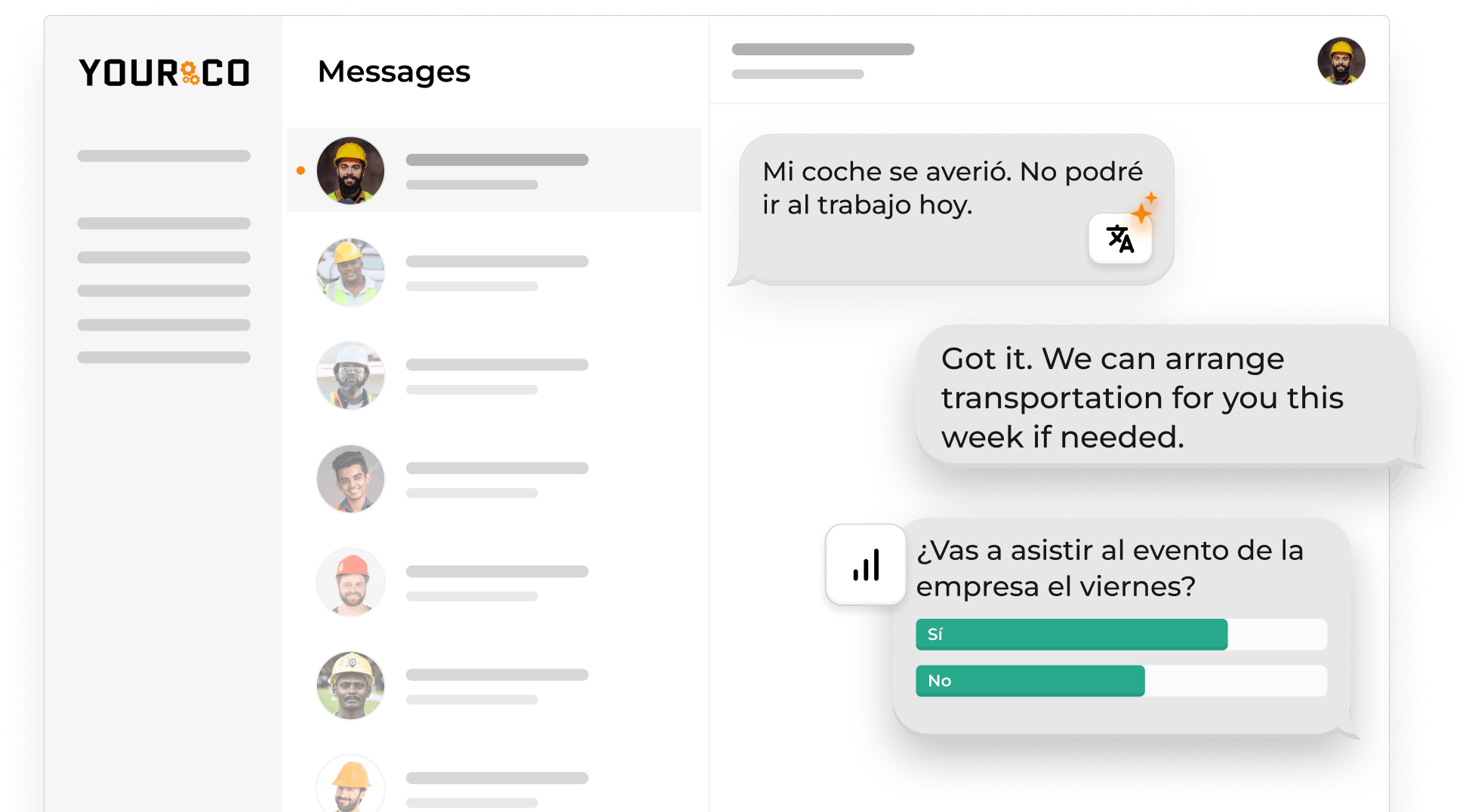
- SMS to any phone: Handbook policies and updates reach every worker through SMS, including workers on basic flip phones. No app, no login, no data plan required.
- Two-way messaging: Workers reply "YES" to confirm they've read and understood a policy. Every response is automatically recorded, timestamped, and linked to the worker's ID, creating the audit trail that inspectors and legal teams look for.
- AI translation across 135+ languages: Policies are automatically delivered in each employee's preferred language. Employee replies are translated back for managers, eliminating the manual translation bottleneck that delays compliance.
Yourco integrates with 240+ HRIS and payroll systems, automatically synchronizing employee rosters, language preferences, and location data.
Enterprise Bridge provides corporate leadership with a one-way broadcast channel to deliver policy updates and critical communications to every frontline location simultaneously. Local managers maintain direct two-way conversations with their teams for questions and follow-up.
Frontline Intelligence gives HR and operations teams centralized visibility into policy acknowledgment rates across all locations. Leadership can identify where policies go unacknowledged, spot communication gaps early, and make proactive decisions across the organization.
"We have nearly 700 employees and 80% are non-desk based, communication is a challenge. Yourco provides a quick easy way to reach everyone and a secure way for employees to reach HR and leadership without a computer."
— Felisha Parker, VP Human Resources, McCarthy Auto Group
After 90 days with Yourco, two-way employee engagement increased to 86%.
For the research behind SMS-based frontline communication, explore Yourco's Closing the Comms Gap study of 150 HR leaders.
Try Yourco for free, or schedule a demo to see the difference the right communication solution can make in your company.
Frequently Asked Questions About Employee Handbooks for Frontline Teams
How often should you update your employee handbook?
Review it at least annually, and sooner when laws or internal policies change. Multi-state employers often need interim updates.
What handbook sections are legally required for frontline employers?
No federal law requires maintaining an employee handbook, but specific disclosures within it may be required by federal, state, and industry regulations. Common examples include anti-harassment and anti-discrimination policies, FMLA procedures, workers' compensation notices, OSHA safety protocols, and paid sick leave policies in states that mandate them.
How do you distribute a handbook to workers without email or computer access?
SMS-based platforms like Yourco deliver handbook policies directly to any mobile phone, including basic flip phones, without requiring app downloads or internet access. Workers can acknowledge policies by replying to a text, and every response is automatically timestamped and logged for compliance documentation.
What should a probationary safety training checklist include?
A strong checklist covers emergency procedures, hazard communication basics, role-specific PPE requirements, injury reporting procedures, and early acknowledgment of the anti-retaliation policy. It then moves into job-specific training, equipment certifications, and competency verification before the probationary period ends.
What are the biggest legal risks of an outdated employee handbook?
Outdated handbooks can weaken your defenses in retaliation claims, wage disputes, and safety violation cases. If your handbook describes processes your organization does not follow or lacks important policies, such as accommodation procedures, employers may face greater exposure.