
For frontline operations across multiple locations, document access often breaks down long before the work begins. Standard Operating Procedures (SOPs) may live in filing cabinets, safety policies may sit in shared drives nobody checks, and compliance records can hide in inboxes frontline workers never open. Teams need this information to do their jobs safely and correctly, but many legacy systems were designed primarily for desk-based employees with laptops and corporate email. Document analytics changes by using AI to extract, organize, and activate the knowledge buried across an organization's files.
TL;DR
- AI, Optical Character Recognition (OCR), and Natural Language Processing (NLP) turn static files into queryable intelligence
- A four-phase pipeline captures, extracts, synthesizes, and integrates document data
- Dispersed frontline workforces carry the highest cost from manual document handling
- Automating repetitive document workflows speeds onboarding and cuts manual work
- A focused rollout across two or three sites builds a defensible Return on Investment (ROI) case before scaling
- SMS-based platforms like Yourco deliver document intelligence to frontline workers on any phone
Define Document Analytics and Why It Matters Now
Traditional document management systems scan and store files. Document analytics goes further: it interprets document content using technologies such as Intelligent Document Processing (IDP) to capture both structured and unstructured data, and then connects that data to enterprise workflows. That distinction matters for operations leaders who need documents to do more than sit in a repository.
For frontline-heavy operations, valuable knowledge can remain trapped inside policies, forms, certifications, and training records, unavailable for day-to-day work.
The table below outlines the practical differences between traditional document management and AI-powered document analytics:
Map the Document Analytics Transformation Pipeline
The pipeline operates across four phases, each building on the last to move raw files toward actionable outputs.
- Phase 1: Capture and Classification. Documents enter the system from any source: mobile scans, email attachments, shared folders, or Application Programming Interface (API) connections. NLP processes text and interprets its context for classification. It routes safety policies differently from training records, even when they share similar terminology.
- Phase 2: Data Extraction. The system pulls structured fields from unstructured content. It handles fixed-format forms and less-structured documents, such as certifications or contracts. This extraction layer can process different content categories and improve performance over time.
- Phase 3: Synthesis and Querying. Extracted data feeds a Retrieval-Augmented Generation (RAG) layer. In well-implemented systems, a frontline supervisor can ask what the current lockout/tagout procedure is for Line 3 and receive the procedure steps with a citation to the document version and approval date. That makes policy libraries and SOP collections far more usable in the flow of work.
- Phase 4: Workflow Integration. Extracted data flows directly into downstream systems. A completed training record updates an HRIS certification status and triggers a renewal alert. An updated SOP version pushes a re-acknowledgment workflow to affected employees.
Where Frontline Document Workflows Break Down
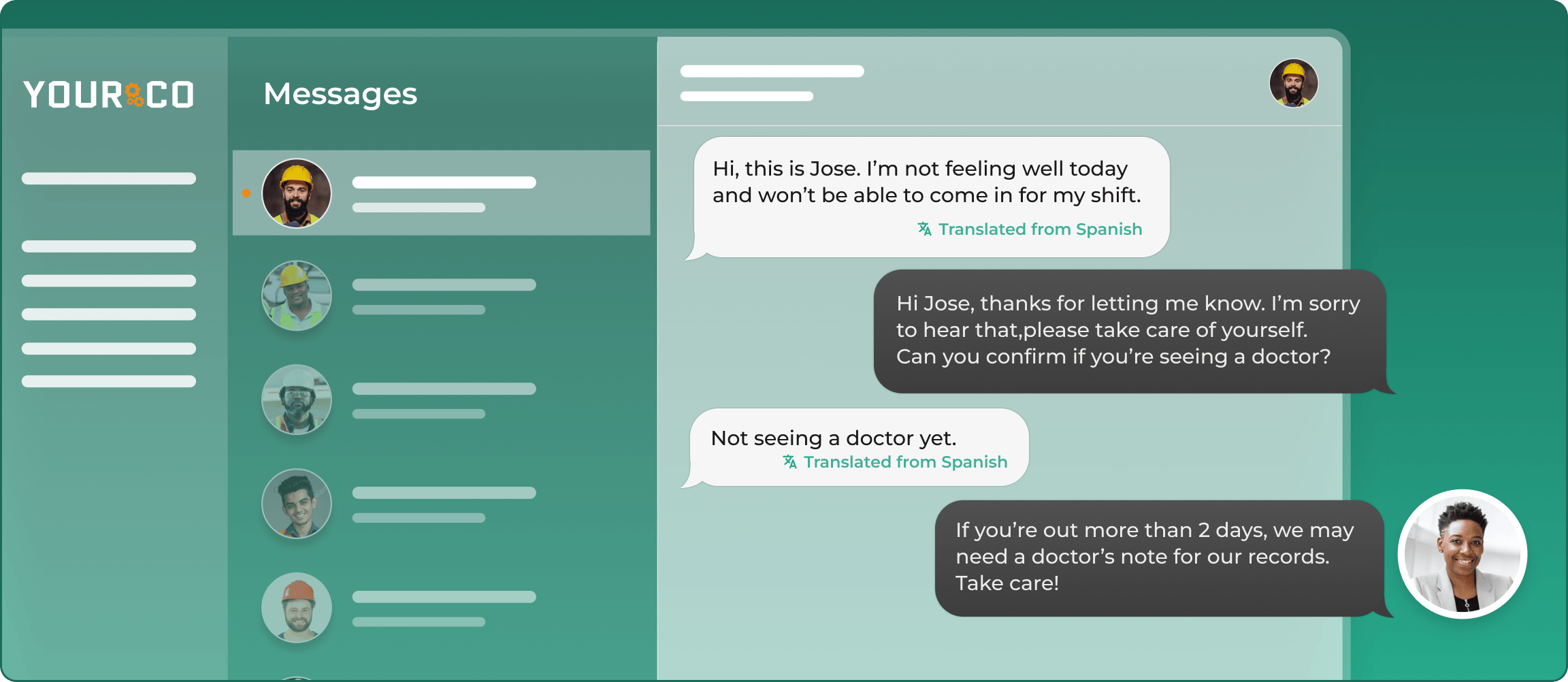
Frontline workers constitute a large share of the global workforce, yet document workflows designed around corporate email or intranet portals structurally exclude many of the workers they are meant to serve.
64% of HR leaders say it is much harder to reach non-desk employees than desk-based employees, according to a Yourco-commissioned survey of 150 HR leaders. When SOPs, compliance records, and policy updates depend on email-first or app-first workflows, the people closest to the actual work often see them last.
Several recurring breakdowns make this worse for multi-location frontline operations:
- Informal channels fill the documentation void: in some environments, word-of-mouth and supervisor relay still supplement formal documentation, which means policy interpretation varies by location and shift
- HRIS-only systems leave documentation gaps: when document management lives separately from the HRIS, duplicate data entry and audit blind spots become common
- Construction and field operations lose productive hours: tracking down documents and addressing rework consume time that could go to billable work
- Onboarding paperwork fragments at scale: as organizations add locations, standardized onboarding documentation becomes harder to maintain, and inconsistent first-year training creates downstream risk
This information is for general awareness only. For specific compliance guidance, consult with qualified legal professionals.
Each of these issues compounds with every additional location an organization operates. A manageable local problem can become a systemic drag on safety and compliance.
Capture Five Measurable Benefits From Document Analytics
Document analytics changes the economics of document-heavy operations in ways leaders can actually measure.
- Faster document turnaround: in many implementations, the time between document receipt and downstream action drops sharply, so critical information reaches decision-makers sooner
- Reduced manual data entry: automated indexing and field extraction reduce time spent re-keying data across systems
- More continuous compliance monitoring: AI systems can flag missing or expiring certifications and incomplete forms automatically, shifting compliance toward continuous monitoring rather than reactive auditing
- Headcount efficiency at scale: IDP platforms can typically handle increasing document volumes without proportional headcount increases, an advantage for enterprises adding sites
- On-demand SOP access: frontline workers can query SOPs and training materials through conversational AI at any hour, so supervisors receive fewer routine procedural questions
These benefits multiply when document intelligence reaches the workers who need it most.
Apply Document Analytics to Real-World Frontline Operations
In multi-location organizations, document analytics can reduce manual handling and standardize critical workflows.
For manufacturing onboarding efficiency, a Datamatics case study reports that a Texas-based manufacturer operating in subsea equipment, maritime logistics, and space systems achieved a 90% reduction in the time required to process pre-employment paperwork after deploying onboarding automation. Results vary by organization and implementation, but the underlying pattern is consistent: when intake, signature, and routing move from paper to a cloud workflow, the time between offer and first day on the job drops.
85% of HR leaders say their non-desk employees express frustration about how they communicate with their managers, according to the same Yourco-commissioned survey of 150 HR leaders. Even strong document automation only delivers value if frontline workers can receive and acknowledge updates on devices they actually use.
For construction safety compliance, organizations that adopt digital daily reports and audit-ready documentation typically transition from paper-based safety records to searchable digital records that surface during inspections. The combination of automated capture and structured retrieval gives compliance teams a clearer audit trail without adding administrative overhead.
How to Roll Out Document Analytics Across Multi-Site Operations
Document analytics projects fail less often because the technology doesn't work and more often because the rollout was designed in a way that made the results hard to act on. A handful of choices upfront determine whether early data will support a chain-wide expansion.
Four decisions tend to determine how useful the early results will be:
With those choices in place, leaders can review early results against the original business case and make a clear scale-or-stop decision rather than relying on impressionistic feedback from one or two stakeholders.
Deliver Document Intelligence to Every Frontline Worker With Yourco
The document analytics pipeline transforms static files into structured intelligence. Delivery still determines whether frontline workers receive that intelligence quickly and consistently. Yourco closes that last step with an SMS-based communication platform built for frontline operations.
Core capabilities:
- SMS to any phone, including basic flip phones, with no app download, no Wi-Fi, and no data plan required
- Two-way messaging for real-time feedback, policy acknowledgments, and individual conversations between managers and frontline employees
- AI-powered translation across 135+ languages and dialects, with each employee receiving messages in their preferred language automatically
Yourco integrates with 240+ HRIS and payroll systems, syncing employee status updates, role changes, and language preferences across platforms.
Enterprise Bridge enables corporate leadership to broadcast policy and SOP updates across all locations simultaneously, while local managers maintain direct communication with their teams.
Frontline Intelligence gives operations and HR teams centralized visibility into how frontline workers engage with document-related communications across all locations. Teams can track policy acknowledgment rates by location, see where important updates go unanswered, and review engagement trends that help leadership make better decisions across sites.
"Yourco has helped me streamline communication between the field and the corporate office. The software is easy to use, and their service department is always available to help when needed."
– Roxana Abreu, HR Director, Central Civil Construction
After 90 days on Yourco, companies see two-way employee engagement reach 86%.
Try Yourco for free today, or schedule a demo to see the difference the right workplace communication solution can make for your company.
Frequently Asked Questions About Document Analytics
What is document analytics, and how does it differ from document management?
Document analytics uses AI, OCR, and NLP to interpret document content and connect extracted data to workflows. Traditional document management focuses on storing and organizing files. Document management keeps documents accessible, while document analytics helps turn them into usable operational information.
How long does it take to see ROI from document analytics?
Results vary by organization and implementation. ROI usually becomes clear after a focused first-phase rollout with one document type and a small number of locations. Compare manual effort and processing speed before and after automation, then review error rates against the same baseline.
Can frontline workers without email or apps access document intelligence?
Yes, SMS-based platforms like Yourco can deliver policy updates and SOP information directly to any mobile phone, including basic flip phones. That makes document intelligence usable for frontline teams who do not rely on email or workplace apps during the day.
Which document types should I prioritize automating first?
Start with documents that are high volume and tied to repetitive downstream workflows. Training records, onboarding forms, compliance certifications, and inspection documents are common starting points. These workflows usually create visible delays, which makes improvement easier to measure.
How does multi-location document intelligence work across different sites?
Multi-location document intelligence works best when organizations standardize on a single workflow, prove it in an early-phase rollout, and then expand it across similar sites. Once the model and process are stable, leadership can monitor throughput and adoption across locations from a central view.