
In a crisis, text messages reach people that email does not. SMS has a 98% open rate, an industry-standard benchmark, which matters most for frontline workers, who typically lack access to company email or intranets.
Crisis communication in HR means ensuring every employee receives accurate information during workplace emergencies, natural disasters, public relations incidents, and other disruptive events. A strong HR framework plans around those reach gaps with multi-channel delivery, clear roles, and tested fallbacks.
TL;DR
- Crisis communication in HR covers preparation, response, and recovery across every employee group.
- Frontline workers are the hardest to reach because email and intranets rarely reach them.
- A layered, multi-channel approach with clear roles, pre-translated templates, and tested fallbacks reduces failure points.
- OSHA 29 CFR § 1910.38 and § 1910.165 shape how many employers design their emergency communication infrastructure.
- Post-crisis reviews surface the gaps that only become visible after a real activation.
- SMS-based platforms like Yourco reach every frontline employee on any mobile phone without requiring an app, login, or company email.
The Crisis Communication HR Landscape
Crisis communication in HR has shifted from reactive to proactive as workforces have become more distributed and the costs of failure have become more visible. HR is expected to provide accurate information to every employee throughout a disruptive event, translating executive decisions into terms employees can act on.
According to Gallup's 2024 data, U.S. employee engagement has hit a 10-year low, and engagement among frontline‑relevant segments, such as younger and non‑managerial workers, also sits well below target levels. Poor crisis communication not only creates safety risks; it accelerates the disengagement and turnover HR teams are already fighting.
Building a Crisis Communication HR Framework for All Employees
HR crisis communication covers workplace emergencies, organizational changes, PR issues, natural disasters, technology failures, and public health crises. Each demands clarity on safety protocols and safety during natural disasters, consistent messaging across locations, and trusted internal sources for context. A strong framework reaches every employee during these events, including workers in the field, on overnight shifts, or in environments where company-wide email will never land. Most emergency communication plans fail on human factors rather than technology: staff don't respond, contact information is outdated, and coordination breaks down. These access failures hit frontline workforces hardest.
Pre-Crisis: Create a Robust Communication Infrastructure
Developing effective communication strategies in advance reduces the margin for error when speed matters most:
- Form a crisis communication HR team assigned to shift positions rather than named individuals, with clear approval authority for each message type.
- Create accessible channels that do not depend on company email or intranet, prioritizing mobile. 98% of U.S. adults own a cellphone, a figure that is very high across income groups, according to the Pew Research Center’s mobile‑technology data.
- Maintain updated contact information and pre-translate multilingual resources before a crisis, not during one.
According to a Yourco-commissioned survey of 150 HR leaders, 88% say they need a reliable way to consistently communicate with frontline employees, yet only 55% feel confident they have that solution. That gap is where most crisis communication breakdowns begin.
During Crisis: Execute Effective Crisis Communication HR Strategies
Rapid execution relies on proven internal communication strategies:
- Respect the "golden hour" and deliver initial communications within 60 minutes with clarity, consistency, compassion, and competence.
- Follow a 15-20-60-90 timeline. Acknowledge within 15 minutes, share confirmed facts by 20, provide details by 60 and prepare wider communications by 90.
- Use tiered, multi-channel messaging. Segment by location, department, and shift, and push through multiple channels simultaneously. Multi-channel notifications generate higher response rates than single-channel alerts.
- Prevent information gaps. Regular updates reduce rumors; workers who learn of them second-hand disengage faster.
According to a Yourco-commissioned survey of 150 HR leaders, 93% believe clear communication on safety reduces workplace incidents, which turns the 15-20-60-90 timeline from a framework into an operational priority.
Reach Frontline Workers During Crisis
Most crisis plans fail on access before they fail on content. HR teams send carefully written communications and then learn that most of the frontline never saw them. At a manufacturing plant, construction site, or hotel, the gap between headquarters and the floor poses a greater emergency preparedness risk than almost any other factor.
What Emergency Communication System Works for Frontline Workers
No single channel reliably reaches every frontline worker. OSHA 29 CFR § 1910.165 sets a performance standard that alarm systems be perceivable by all affected employees, which points toward a layered approach.
Build the architecture so each layer compensates for the failure mode of the one above it. Many employers treat the supervisor chain as a baseline expectation, not a fallback of last resort.
Unique Communication Challenges for Distributed Workforces
Frontline workers often have no company email, work in environments that block digital access, move across multiple shifts and locations, and may not share a common language with headquarters.
On top of those reach barriers, noise on a manufacturing floor masks audible alarms; healthcare teams move between departments at all hours; transportation workers are in motion; and construction and retail crews work across sites or customer floors where supervisors cannot see them at once.
University of Kentucky research, documented by EHS Today, found that manufacturing workers strongly prefer safety information they perceive as trustworthy, often delivered verbally by their direct supervisors, which makes supervisor‑led communication a preferred channel rather than a workaround.
Technology Solutions for Inclusive Crisis Communication HR
SMS text messaging is the most effective channel for reaching frontline workers outside a fixed facility. The Society for Human Resource Management (SHRM) notes that mobile technologies, including texting, are highly effective for reaching and engaging the workforce, and near‑universal cellphone ownership means SMS can reach most workers even without smartphones or continuous internet access. SMS-based platforms like Yourco enable location and shift segmentation, Human Resource Information System (HRIS) integration, and AI-powered translation across 135+ languages and dialects.
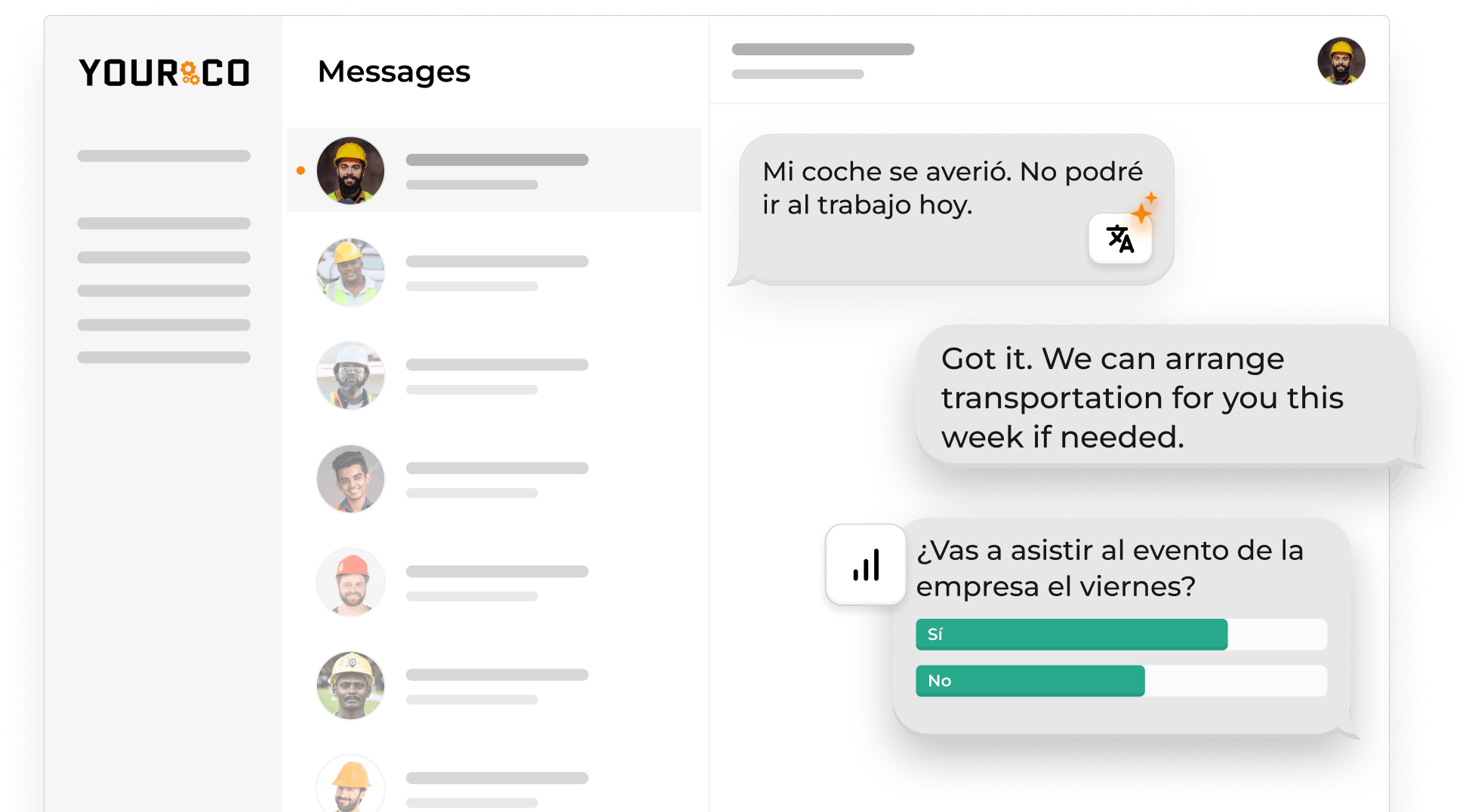
Workers using personal devices should opt in, and SMS should be paired with on-site channels, given the risk of cellular overload during mass events. Digital signage reinforces on-site alerts, supervisor-led cascades carry safety-critical messages in manufacturing, and multi-channel platforms enable simultaneous delivery across SMS, voice, push, and email, with delivery tracking.
Implementation Guide: Set Up Crisis Communication HR for Frontline Workers
- Audit capabilities. Inventory channels, survey worker preferences and review past responses.
- Map communications. Document primary and backup channels, offline fallbacks, and shift-specific contacts per site.
- Deploy rapid-response tools, including pre-approved templates and documented escalation protocols.
- Test across all shifts. Ready.gov recommends exercises that validate plans across all shifts, not just day coverage.
Strengthen Crisis Communication HR Systems Post-Crisis
Post-crisis review closes gaps between what the plan assumed and what actually happened. Use surveys, focus groups, and interviews to measure what actually reached each shift and language group, how fast each channel delivered, whether the frequency and clarity worked, and whether supervisors had the information they needed to cascade the message. Then update plans, set an annual review, and build mental health and Employee Assistance Program (EAP) resources into follow-up communications.
The National Safety Council documents that frontline employees can face elevated trauma and mental health risks after workplace crises, making post‑incident support and recovery planning essential.
Address Legal and Ethical Considerations in Crisis Communication HR
For HR and operations leaders running frontline workforces, OSHA is the most commonly referenced framework. Many employers follow OSHA 29 CFR § 1910.38, which requires a written Emergency Action Plan for workplaces with more than 10 employees. The plan must address emergency reporting; evacuation and exit route assignments; employees who remain to operate critical processes before evacuating; accounting for employees after evacuation; rescue or medical duties; and the name or job title of the person employees can contact with questions.
Guidelines suggest the EAP is reviewed with each employee when the plan is developed, when responsibilities change, and when the plan changes. OSHA 29 CFR § 1910.165 also addresses alarm systems and annual testing, with backup means such as employee runners or telephones when primary systems are unavailable.
This information is for general awareness only. For specific compliance guidance, consult with qualified legal professionals.
Multilingual Communication Considerations
Many employers follow OSHA guidance and the General Duty Clause to deliver safety training in the language workers understand. Pressing the best English speaker into an informal interpreter role can raise concerns about miscommunication under stress, so designating bilingual safety liaisons with verified communication competency is a widely adopted approach. Regulations such as the Health Insurance Portability and Accountability Act (HIPAA), the Family Educational Rights and Privacy Act (FERPA), and securities laws also shape what can be shared during specific crises; focus communications on processes, timelines, and support channels rather than identifiable individual details.
Use Crisis Communication HR Templates and Tools
Pre-approved message templates eliminate approval bottlenecks when speed matters most. Develop and test them before any event, and store them where they are accessible outside normal working hours.
- Initial notification (15 minutes): URGENT header with crisis type and location; what we know, what we're doing, what to do, next update time and emergency contact.
- Regular update (60 minutes): Update the header with the current situation, actions completed, next steps, timeline and resources.
- Resolution: RESOLVED header with summary, final status, return-to-operations guidance, follow-up actions, and ongoing support, including EAP contact.
A few practical rules make these templates work. Keep SMS messages under 160 characters, use plain language, spell out acronyms, and send translated versions alongside the English version, not as a follow-up.
Reach Every Frontline Employee in a Crisis With Yourco
Crisis communication only works when the message reaches the worker who needs it. Yourco is an SMS-based employee communication platform built for frontline workforces, giving HR a reliable way to deliver urgent updates during any disruption without email, apps, or office access.
Core capabilities include:
- SMS to any phone, including basic flip phones, with no app download, WiFi, or data plan required
- Two-way messaging so HR can confirm every worker is safe and accounted for
- AI-powered translation across 135+ languages and dialects
- Scheduled messages, polls, and segmentation by location, role, or shift
Yourco connects to 240+ HRIS and payroll systems, so employee contact data stays up to date without manual upkeep. Enterprise Bridge enables one-way broadcasts from corporate leadership to every frontline location simultaneously, keeping sites aligned without requiring responses.
Frontline Intelligence provides HR and leadership teams with centralized visibility into how crisis communications perform across all locations. Teams can see which sites had the slowest response times, where acknowledgments lagged, and which locations need follow-up, so headquarters can spot risk patterns before they become incidents.
"Yourco has been huge for us, especially during the weather crisis. We were able to keep our employees safe and make sure everyone was notified of updates in a timely manner."
— Scott Pfantz, Operations Manager, Nufarm - Alsip
After 90 days on Yourco, companies see two-way employee engagement reach 86%.
Try Yourco for free today, or schedule a demo to see the difference the right workplace communication solution can make for your company.
Frequently Asked Questions About Crisis Communication in HR
What is crisis communication in HR?
Crisis communication in HR is the process of delivering timely, accurate, and actionable information to all employees during disruptive events, including workplace emergencies, natural disasters, organizational changes, and public health crises. The core challenge for HR teams with frontline workforces is designing systems that reach workers without company email or desk access across multiple locations and shifts.
What emergency communication system works for frontline workers?
No single channel reliably reaches every frontline worker, so the most effective approach is layered. Hardwired alarms handle on-site notification; SMS-based platforms like Yourco reach workers outside the facility or between shifts; supervisor-led verbal communication carries safety-critical messages; and two-way radios cover construction and outdoor logistics.
Does OSHA require a written emergency action plan?
Many employers follow OSHA 29 CFR § 1910.38, which outlines a written Emergency Action Plan for organizations with more than 10 employees. It typically covers evacuation procedures, alarm systems, procedures for accounting for employees after evacuation, and designated contacts. Guidelines suggest the plan is reviewed with each employee when assigned, when responsibilities change, and when the plan changes.
How do you reach non-English-speaking workers during an emergency?
Prepare multilingual resources before any crisis. Many employers follow guidance to deliver safety training and emergency procedures in the language workers understand. Designate bilingual safety liaisons with verified communication competency, not only language fluency, and pre-translate emergency templates into the primary languages of your workforce.
How do you notify frontline employees outside of working hours?
SMS to personal mobile numbers is the most effective channel for reaching workers outside scheduled hours, the common failure point for organizations that rely on email. Workers should opt in to receive work communications on personal devices, the contact database should stay current, and a supervisor phone-call backup should cover anyone who does not respond within a defined timeframe.
What causes emergency communication plans to fail?
Most failures are access and reach failures, not technology failures. The leading causes are a lack of response from recipients and missing or outdated staff contact information. Plans built around email and phone trees frequently break down when a real event occurs outside normal business hours, which is why layered systems with up-to-date contact data and supervisor cascades outperform single-channel approaches.