
Frontline worker shortages create a self-reinforcing cycle: understaffing drives overtime, overtime drives burnout, and burnout drives turnover that deepens the shortage. For HR and operations leaders in manufacturing, logistics, healthcare, and retail, that pressure shows up as unfilled positions, exhausted crews, and labor costs that climb regardless of how reactive scheduling is.
AI workforce planning interrupts this cycle by forecasting demand and identifying flight risk before gaps compound into crises. This guide provides practical steps to help you make that shift.
TL;DR
- Reactive staffing creates a cycle of understaffing, burnout, and turnover that AI workforce planning can interrupt
- AI workforce planning helps teams forecast demand, test scenarios, and act earlier instead of reacting after gaps appear
- A structured implementation framework reduces deployment risk for frontline operations
- Frontline worker adoption depends on augmentation-first communication, mobile access, and human oversight
- Emerging AI tools are changing how frontline workforce planning and upskilling decisions get made
- SMS-based platforms like Yourco help every frontline worker stay connected to the workforce planning communications that affect their roles and shift coverage
Understand Why Reactive Staffing Breaks Frontline Operations
When a frontline worker quits, the remaining team absorbs the workload. Overtime requests climb, fatigue sets in, and then more workers leave.
In manufacturing, 60% of human resources (HR) leaders report the cost to replace a single skilled frontline worker ranges from $10,000 to $40,000, according to Deloitte's 2025 Manufacturing Industry Outlook, citing a UKG Workforce Institute survey of 300+ U.S. manufacturing HR leaders. In healthcare, each 1% change in registered nurse (RN) turnover costs or saves the average hospital $289,000 annually. These are direct consequences of planning that only responds after damage is done.
AI workforce planning can use predictive models to identify flight risk before resignations occur. Machine learning analyzes historical patterns, seasonal trends, and real-time signals to forecast labor demand at the shift level.
Identify the Key Benefits of AI-Powered Workforce Planning
Organizations that invest in AI workforce planning gain capabilities that manual planning cannot match. The four most measurable benefits are outlined below:
- Sharper demand forecasting: AI-driven forecasting improves planning accuracy, reducing labor shortages and overtime exposure before they occur.
- Reduced burnout through better labor planning: Earlier intervention and steadier coverage help teams avoid the constant last-minute gaps that erode morale and retention.
- Faster time-to-competency: AI-optimized learning pathways can shorten the path to proficiency compared to standardized training programs, according to peer-reviewed research.
- Measurable ROI across sectors: Manufacturing and retail organizations report positive AI ROI, according to the 2025 Wharton/GBK AI Adoption Report, with 74% of leaders tracking positive returns despite slower adoption in these sectors.
96% of HR leaders agree better communication tools boost productivity, in a Yourco-commissioned study of 150 HR leaders. As models ingest more operational data over time, forecasting accuracy improves, and the gap between AI-planned and reactively staffed operations widens.
Implement AI Workforce Planning Without the Deployment Risk
Rushing AI deployment without a structured plan backfires. SHRM's frontline workforce technology report warns that hastily deploying advanced technologies can decrease worker engagement and erode trust. The six steps below, drawn from AIHR and SHRM, reduce that risk by building in checkpoints before commitment.
The table below maps each step to its timeline and primary focus so teams can sequence work across workstreams without overlap.
- Define objectives tied to operational pain points: Start with the business problem, identify 2 to 3 specific pain points and define measurable success criteria before evaluating any tool.
- Audit and clean your workforce data: AI models are only as useful as the data they're trained on. AIHR identifies data auditing as a prerequisite, with legal, IT, and data teams defining governance and guardrails. For turnover prediction, the required inputs are historical employee data covering demographics, performance metrics, and absence patterns.
- Pilot with turnover prediction: Turnover prediction is a strong starting point because the required data already lives in most human resource information systems (HRIS) systems, the impact is directly quantifiable, and it demonstrates value without displacement concerns. Scope the pilot narrowly: one job family, one location, 90-day minimum run.
- Select mobile-first vendor partners: Evaluate vendors on mobile-native architecture, HRIS integration depth, explainability controls, multilingual support, and industry-specific case studies. Focus AI efforts on worker augmentation rather than role automation.
- Test workforce scenarios: Run scenario modeling before committing resources. Model demand surges, attrition cascades, skills transitions, and wage adjustment impacts. AIHR notes that AI-driven planning lets organizations test dozens of scenarios before recommending a path forward.
- Measure results and scale only after KPIs are met: Define key performance indicator (KPI) scaling triggers upfront: the pilot achieved target KPI improvement, manager adoption of AI insights is strong, and no significant bias issues were identified.
Engage Frontline Workers During AI Adoption
Only about half of frontline workers regularly use AI tools, but leadership support increases the share of employees who are positive about AI, according to BCG's AI at Work 2025. The gap is not technology resistance. Access and trust are the actual barriers. Three practices make the biggest difference.
- Lead with augmentation, not automation: Organizations using AI are 16 times more likely to enhance frontline jobs than to displace them, but workers do not know that unless leaders say it clearly. Allianz encourages employees to consider how AI could reduce their workloads, framing it as a personal benefit rather than a headcount reduction.
- Build mobile-native access: SHRM notes that frontline workers' training and technology needs have historically been underserved by one-size-fits-all programs designed for office environments. Shift reminders, policy updates, and planning changes need to reach workers on the devices they carry, not desktop portals they cannot access on shift.
- Give workers a structured voice: Gallup research confirms employees with influence over technology adoption are more satisfied with their work. Pulse surveys, employee working groups, and the inclusion of frontline workers on planning teams when new tools are introduced all increase buy-in.
91% of HR leaders report SMS is far more effective than other communication channels, with significantly higher response rates, according to the same Yourco research. When frontline workers can access a tool, understand its purpose, and see that their input shapes how it is used, adoption follows.
Apply Best Practices for Responsible AI Deployment
Trust determines whether AI investment delivers results. Deloitte's Human Capital Trends 2026 found that workers who trust the AI agents they work with are far more likely to see those agents as contributing real value. Four practices build that trust.
- Embed human-in-the-loop oversight: Congressional testimony to the House Education and Workforce Committee notes that responsible AI deployment commonly includes cross-functional oversight committees and human-in-the-loop requirements for consequential workforce decisions.
- Implement data privacy controls: IAPP notes that when employee data is mishandled, the impact is human as much as legal. Common practices include limiting employee access to data, setting retention period rules, and conducting regular audits.
- Start small: Pilot programs give teams space to adjust before scaling broader changes.
- Treat multilingual communication as non-negotiable: Workers who cannot read AI-generated recommendations in their own language cannot participate meaningfully in oversight or feedback.
This information is for general awareness only. For specific compliance guidance, consult with qualified legal professionals.
Prepare for Emerging AI Workforce Planning Trends in 2026
Two developments are reshaping how frontline industries approach AI workforce planning.
Agentic AI is moving from a supporting tool to one that proactively identifies and resolves workforce exceptions with minimal manager intervention. Scheduling gaps, coverage shortfalls, and attrition signals that once required human review are increasingly handled by systems based on predefined parameters. Gartner cautions leaders to define the acceptable range of outcomes in advance and monitor closely for deviations.
Skills intelligence platforms are closing a gap that manual workforce planning has never been able to address at scale. These platforms match individual frontline workers to upskilling pathways based on their current capabilities, role requirements, and projected operational needs. BCG reports that frontline worker confidence in AI has grown, and Gartner predicts hiring processes will increasingly include certifications for workplace AI proficiency. With manufacturing alone needing up to 3.8 million net new employees by 2033, accelerating skills development through AI-enabled learning is no longer optional.
Connect Every Frontline Worker to Workforce Planning Decisions With Yourco
Even the best AI workforce planning system falls short if frontline workers never receive the updates, policy changes, or shift reminders it generates. Yourco closes that last-mile gap with an SMS-based employee communication platform built to reach every worker.
Yourco's core capabilities include:
- SMS to any phone: no app download, no Wi-Fi, no data plan required, including basic phones and flip phones
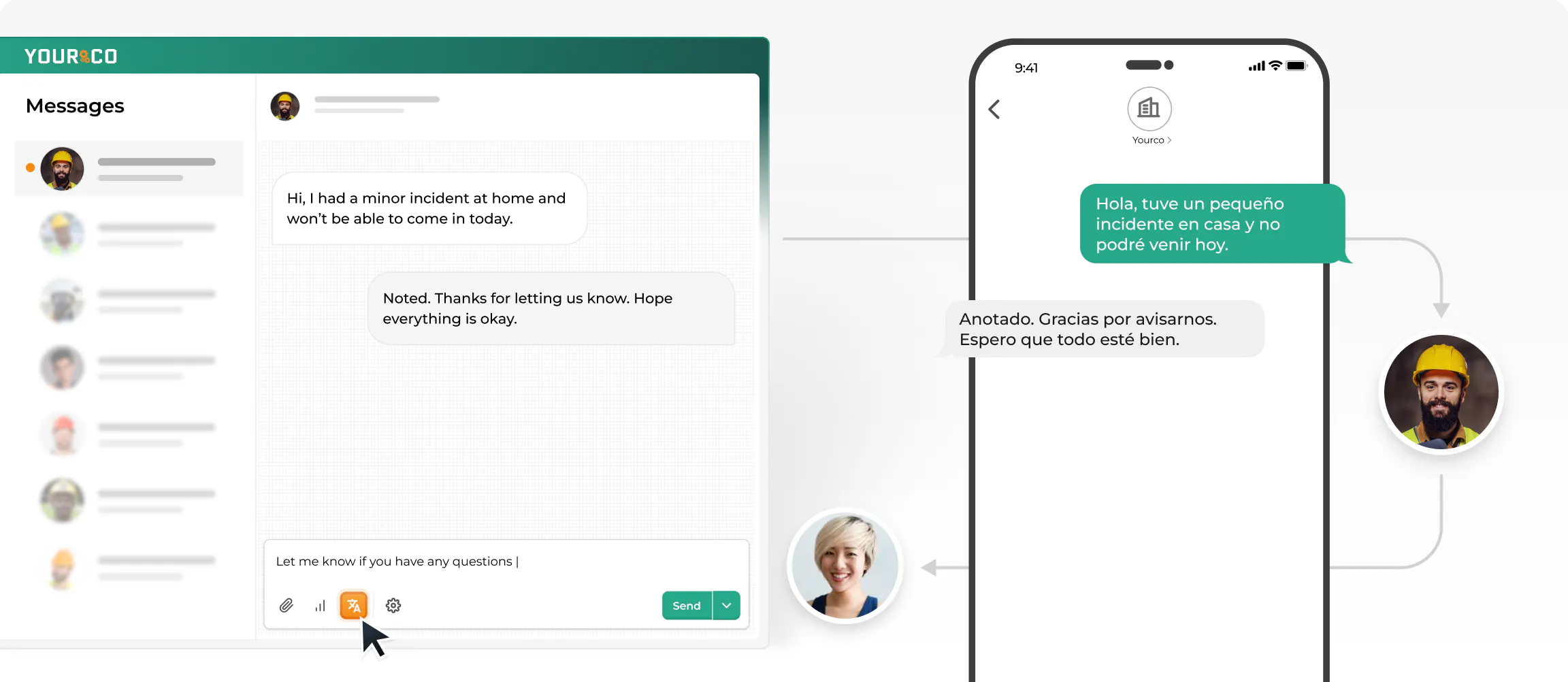
- Two-way messaging: frontline workers can respond, report absences, and ask questions in real time
- AI-powered translation: 135+ languages and dialects, delivered automatically in each worker's preferred language
Yourco integrates with 240+ HRIS and payroll systems, automatically syncing new hires, role changes, terminations, and language preferences so workforce rosters stay current without manual maintenance.
Enterprise Bridge enables corporate leadership to broadcast centralized, one-way workforce planning updates and policy announcements across all locations, while local managers maintain direct communication with their teams.
Frontline Intelligence provides HR and operations teams with centralized visibility into attendance patterns, engagement signals, and workforce communication trends across all locations. It helps leadership identify patterns across sites, generates AI-powered reports on absence causes and shift coverage gaps, and supports more informed decisions about where workforce planning follow-up is needed.
"We use Yourco for our absence management and for sending out notices, reminders, and event announcements. It keeps everyone who needs to know informed when people are absent."
— Kyle Stover, HR Assistant, J-Lenco Inc.
After 90 days on Yourco, companies see two-way employee engagement reach 86%.
Try Yourco for free today, or schedule a demo to see the difference the right workplace communication solution can make for your company.
Frequently Asked Questions About AI Workforce Planning for Frontline Industries
What is AI workforce planning for frontline industries?
AI workforce planning uses machine learning to forecast labor demand, identify potential turnover risk, and model staffing scenarios for shift-based frontline teams. It replaces reactive staffing with a more proactive approach that helps teams prepare earlier and make steadier workforce decisions.
How does AI reduce frontline worker burnout?
AI reduces burnout by helping teams anticipate labor needs earlier and distribute workload more evenly across the workforce. When managers can plan ahead instead of constantly reacting to shortages, frontline workers face fewer last-minute gaps, less overtime pressure, and more stable day-to-day operations.
What should be the first AI workforce planning pilot for frontline teams?
Turnover prediction is a strong first pilot for many frontline teams because the required data often already exists in HRIS systems, and the business impact is easier to measure. Keep the pilot narrow by focusing on one job family in one location before expanding.
How do you communicate AI changes to frontline workers who lack email access?
SMS-based platforms like Yourco help organizations communicate AI-related changes to frontline workers on any mobile device without requiring app downloads or email access. That makes it easier to deliver updates, reminders, and policy changes to workers wherever they are.
What KPIs should you track for AI workforce planning success?
Track operational measures such as turnover, time-to-fill, overtime, and skills gap closure, as well as adoption measures such as managers' use of AI insights. Define baseline performance before the pilot starts so progress can be assessed against a fixed reference point.