
Sales associate turnover in U.S. convenience stores exceeded 100% in 2024, according to NACS, and trade and transportation employers saw total separations swing from 1.35 million in January 2026 to 880,000 in February 2026, according to BLS JOLTS data. For human resources (HR) leaders running these workforces, annual engagement surveys and exit interviews deliver answers months after the people they describe have already left. Closing the distance between when turnover signals appear and when the organization acts on them requires a shift from reactive reporting to a daily, data-driven retention operating system.
TL;DR
- Annual turnover reports describe a workforce that has already churned in high-turnover frontline sectors
- Predictive analytics and pulse surveys detect attrition risk weeks before a resignation
- Schedule predictability, career mapping, manager enablement, and payroll accuracy are the operating levers that reduce frontline exits
- Frontline managers drive a large share of engagement outcomes, and many are overwhelmed by admin tasks that crowd out coaching time
- Workers who feel heard and respected stay longer than workers who simply earn more
- SMS-based platforms like Yourco give frontline teams a direct, two-way communication channel for feedback, workforce metrics tracking, and real-time manager connection
Detect Attrition Risk With Continuous Frontline Workforce Insights
Annual turnover reporting can mask the fast-moving dynamics of frontline workforces. In high-churn sectors like convenience retail, the people included in a year-end report may be very different from the workers the organization was trying to retain earlier in the year.
The first year on the job is a particularly vulnerable period for frontline workers' retention. That makes annual reporting useful for historical context, but often too slow to support timely intervention.
Early-warning signals for frontline attrition often include schedule instability, declining pulse survey participation, early-tenure drop-off, and negative open-text sentiment. These signals should be treated as indicators of risk rather than proof of impending resignation.
- Scheduling pattern changes. CEPR research finds that about 66% of U.S. hourly employees frequently experience volatile work hours driven by employer demands. Shift refusals, reduced pickup rates, and recurring swap requests can be useful leading indicators of disengagement.
- Early-tenure drop-off. Early turnover is often driven by job shock and a mismatch between the role described at the time of hiring and the job's day-to-day reality. Retention benchmarks consistently show the steepest drop-off in the first few months.
- Declining pulse survey response rates. Falling participation can signal disengagement, though it can also reflect survey fatigue, shift timing, language barriers, or access issues. Patterns over time matter more than any single missed response.
- Negative open-text sentiment. AI trend detection applied to employee survey responses can surface friction at the department or site level earlier than exit data alone.
One important caution: trust and visible benefits matter when introducing AI-driven monitoring. Systems perceived as surveillance can accelerate the exits they are meant to prevent. They are more likely to help retention when workers see better schedules, faster pay corrections, and clearer career paths.
Prioritize Schedule Predictability and Flexibility
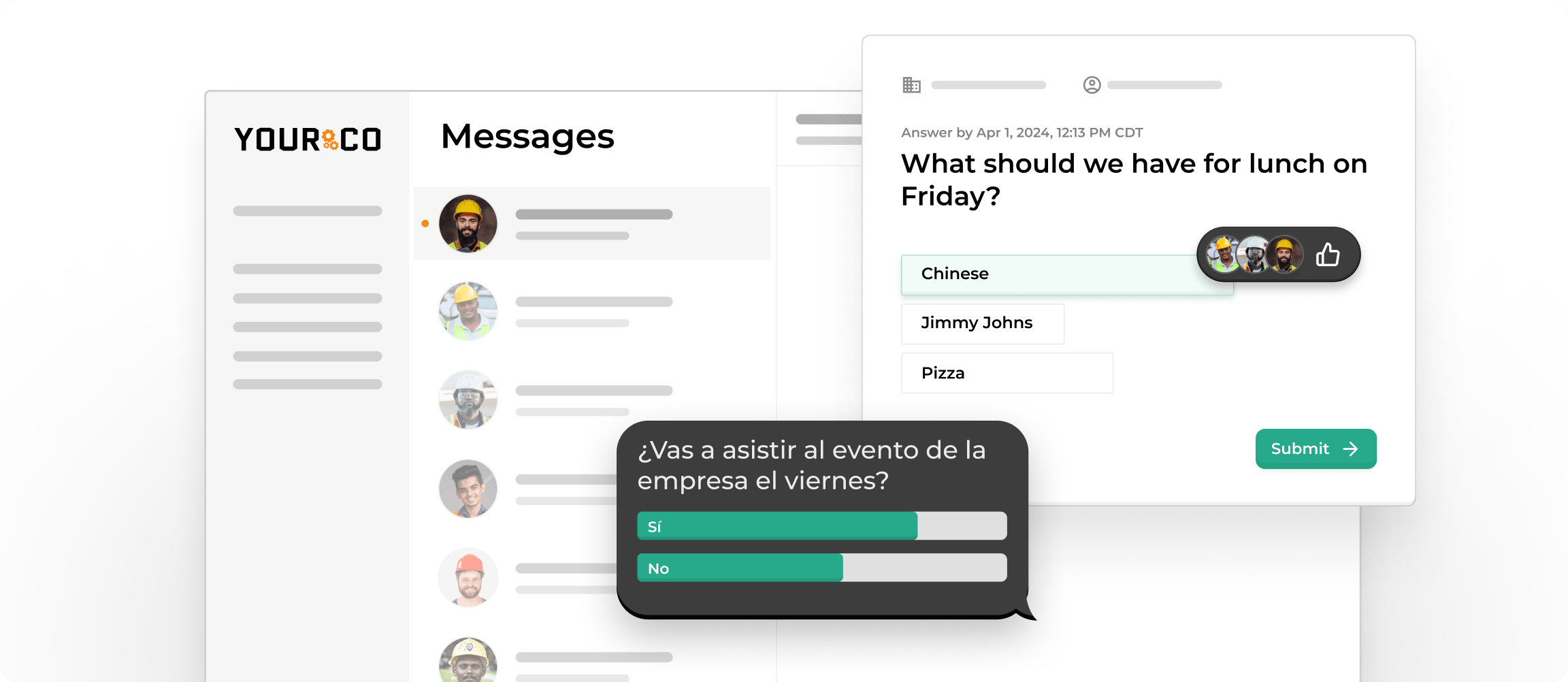
Unpredictable scheduling remains common in many frontline settings, and it is closely associated with higher turnover. Schedule instability leads to work-family conflict, financial strain, lower job satisfaction, and perceived unfair treatment at work. Flexible scheduling practices can help reduce that pressure. In frontline environments, employee input, schedule predictability, and shift-swapping options are associated with better retention and a better employee experience.
Practical steps that can improve outcomes include:
- Posting schedules at least 14 days in advance, where applicable, consistent with many fair workweek laws
- Enabling shift swapping through mobile-friendly self-service tools
- Providing a good-faith hours estimate at hiring and updating it when work patterns change
- Communicating schedule changes through direct, timely mobile channels so workers actually receive them
This information is for general awareness only. For specific compliance guidance, consult with qualified legal professionals.
Build Visible Career Pathways to Retain Frontline Talent
Career stagnation is a persistent driver of voluntary turnover in frontline workforces. When workers cannot see a path from their current role to a better one, the calculation to stay weakens. Organizations that build structured, skills-based career planning for hourly roles tend to retain more workers and promote from within more often.
Career mapping for hourly roles should include:
- Identifying the skills workers still need for specific target roles
- Certificate programs and educational assistance with measurable progression
- Management-skill development beyond technical skill tracks
- Explicit communication of advancement criteria
Workers are more likely to stay when advancement feels visible and reachable rather than vague. That is especially true in frontline environments where employees often do not see a clear path from today's role to next year's opportunity.
Give Frontline Managers the Time and Tools to Coach
96% of HR leaders agree that better communication tools boost productivity, according to a Yourco-commissioned survey of 150 HR leaders. Managers account for at least 70% of the variance in frontline engagement, according to Gallup. That same research shows many voluntary departures are preventable, with departing employees reporting that their manager or organization could have done something different.
Gartner research found that only 27% of HR leaders are satisfied with the effectiveness of their frontline managers, and only 38% of employees are satisfied with their manager's quality. Admin tasks consume the time managers need for coaching, recognition, and connection. Automating routine communications such as schedule-change reminders, policy acknowledgments, and absence reporting frees hours each week that managers can redirect toward the interactions that actually retain people.
Evidence-based manager retention tactics include:
- Weekly recognition routines. Consistent recognition lands more meaningfully when it is tied to observable behaviors rather than tenure alone. Consistency matters more than cost.
- Five-minute team huddles. Brief daily or weekly check-ins create structured moments for recognition and surface operational issues early.
- Informal 1:1s. Even a two-minute conversation during a shift change, when done regularly, signals that the manager sees the worker as a person, not a headcount number.
Connect Payroll Accuracy to Trust and Baseline Retention
The ADP 2024 Global Payroll Survey found average global payroll accuracy to be 78%, indicating that payroll errors are common enough to affect employee trust. For hourly workers with shift differentials, overtime, and variable pay, these errors carry outsized consequences. Workers often interpret payroll accuracy as a signal of how much they are respected by the organization.
Pay transparency is the second factor that shapes whether compensation builds trust or erodes it. Most employees know what they earn, but far fewer understand how their total compensation is calculated, turning pay from a retention tool into a source of distrust.
Actionable steps for payroll clarity:
- Provide plain-language paystub explanations for workers with variable pay components
- Resolve errors visibly and quickly, since correction speed signals respect
- Train managers to discuss compensation confidently during reviews
- Communicate pay ranges and advancement criteria in direct, accessible language
Being treated fairly and with respect often matters more to younger hourly workers than income level alone.
Compare Reactive and Data-Driven Frontline Retention Approaches
The contrast between reactive and data-driven retention is most visible across six dimensions:
Run a Data-Driven Retention Diagnostic at One Site First
The fastest path to a working operating system is to test the approach at one site, shift, or region and prove the metrics before scaling. A useful diagnostic includes:
- Tracking voluntary and involuntary turnover separately, with new hire retention measured as distinct tenure cohorts
- Capturing absence rates as a leading indicator, not just a staffing metric
- Deploying mobile-accessible pulse surveys and monitoring schedule pattern changes, such as shift refusals and swap frequency, as retention signals
- Enabling manager alerts when engagement or attendance signals deteriorate
- Benchmarking pay competitiveness against local market rates and assessing career pathway visibility for frontline roles
- Measuring whether workers feel heard through a dedicated survey question
- Connecting payroll, HR, and engagement data, then building real-time dashboards segmented by location, shift, and tenure cohort
- Establishing a response protocol so that detected signals trigger manager action within two business days
Turn Retention Signals Into Action With Yourco
Turning frontline workforce insights into daily action requires a communication channel that reaches every worker, on every shift, in every language. 88% of HR leaders believe better communication tools can reduce employee churn, according to the same Yourco-commissioned survey of 150 HR leaders. Yourco is the SMS-based employee communication platform built for exactly this reality.
Core communication capabilities:
- SMS to any phone, from smartphones to basic flip phones, with no app download, no Wi-Fi, and no cost to employees
- Two-way messaging that enables real-time conversations between managers, HR, and frontline teams
- AI-powered translation across 135+ languages and dialects, so every worker receives messages in their preferred language
Yourco integrates with 240+ HRIS and payroll systems to automatically sync employee data.
Enterprise Bridge lets corporate leadership send centralized updates across all locations, while local managers maintain direct communication with their teams.
Frontline Intelligence gives HR and operations leaders centralized visibility into engagement trends, sentiment, and communication patterns across all locations. It surfaces disengagement signals, flags safety and conflict indicators, and delivers AI-powered reporting that lets leaders query call-off patterns, absence causes, and schedule-change communication trends. For teams building a data-driven retention operating system, Frontline Intelligence provides the cross-site visibility that annual reports cannot.
"Getting a lot more response from employees than we have in the past, and it's so easy to just be able to send out a quick text company-wide, or just to a specific group. We love it!"
– Maddy Kristjanson, Human Resources Generalist, Plymouth
After 90 days on Yourco, companies see two-way employee engagement reach 86%.
Try Yourco for free today, or schedule a demo to see the difference the right workplace communication solution can make for your company.
Frequently Asked Questions About Data-Driven Frontline Retention
Why is annual turnover reporting insufficient for frontline teams?
Annual reports flatten fast-changing frontline conditions into a delayed summary. In high-turnover environments, the workforce can change substantially before leaders review the data. That makes annual reporting useful for historical review but too slow for daily retention decisions that need to be made at the shift or weekly level.
What are the strongest early-warning signals for frontline attrition?
The clearest early-warning signals are changes in scheduling patterns, declining pulse survey participation, recurring swap requests, and onboarding drop-off in the first few months. When several of these signals appear together, managers have a better chance of spotting risk early enough to intervene before a resignation happens.
How does schedule predictability affect frontline worker retention?
Schedule predictability supports retention by reducing stress and disruption in workers' daily lives. When hours and shift timing feel unstable, workers experience conflict at home, financial strain, and frustration with supervisors. More predictable schedules help reduce that friction and make staying feel more sustainable.
What is the single biggest controllable factor in frontline retention?
Manager capability is often the biggest controllable factor in frontline retention. Workers stay longer when managers coach consistently, recognize good work, and address issues early. Even short, regular check-ins can strengthen trust and help managers catch problems before they grow into attendance issues or resignations.
How can organizations collect real-time feedback from workers without email access?
SMS-based platforms like Yourco can collect real-time feedback without requiring access to company email. They deliver pulse surveys, capture responses, and support two-way conversations on any mobile phone, including basic devices. That makes it easier for frontline workers to participate without downloading an app or logging into another system.