
Many employee voice programs never reach the frontline workers whose feedback matters most. A factory operator with something to say often cannot use a listening stack built around enterprise social networks. Hotel housekeepers and truck drivers face the same access problem when programs rely on internal forums or meeting transcripts. HR and operations leaders need to capture and analyze feedback through the channel workers already carry in their pockets, then act on what they learn.
TL;DR
- Employee voice is how workers express views and influence decisions; employee sentiment is how they feel and why. Neither involves speech nor vocal-tone analysis.
- Conventional voice programs assume access to computers or company logins, so many frontline workers never reach them.
- Reaching every worker requires the channel frontline workers already use every day: SMS. AI can then analyze that text.
- A frontline-ready listening ecosystem combines regular text check-ins with lifecycle and always-on feedback throughout the year.
- AI text analysis surfaces multilingual sentiment and location-level patterns, including disengagement signals that may indicate retention risk.
- SMS-based platforms like Yourco turn everyday text messages into visibility into sentiment and retention risk across every location and shift.
Define Employee Voice and Employee Sentiment Before You Measure Either
Clear definitions matter because conflating these terms leads to programs that measure the wrong thing. Employee voice is the ability of workers to express their views, concerns, and suggestions, and to have those ideas influence decisions at work. Voice is the mechanism. The word is metaphorical: it means having a say and influencing decisions through feedback.
Employee sentiment describes how employees feel about their job and workplace, and why, ranging from satisfaction and motivation to frustration and disengagement. Sentiment is the emotional state. Voice is the act of expressing it.
These distinctions matter for what teams buy and build. Core concepts separate as follows:
- Employee voice: the right and mechanism for workers to share views and shape decisions.
- Employee sentiment: the emotional and attitudinal state of the workforce.
- Employee sentiment analysis: the analytical process, using natural language processing (NLP) on text, to interpret that sentiment.
- Speech analytics: acoustic analysis of recorded audio, relevant to call centers.
Getting these straight keeps the focus where it belongs: on giving workers a say and reading what they write back.
Recognize Why Conventional Voice Programs Skip the Frontline
The standard employee voice stack assumes a desk. Enterprise social networks, internal forums, collaboration-tool chatter, and meeting transcripts all require company login and workstation time, which many frontline workers lack. Limited computer access during the workday, irregular schedules, and the absence of face-to-face communication all reduce how often frontline workers can use traditional feedback channels.
This creates a two-tiered listening system. Office staff fill out the survey and join the all-hands; many frontline workers never see either. Low participation should prompt leaders to check access barriers before assuming disengagement.
The stakes are higher than a low response rate. SHRM has reported elevated rates of job changes among frontline employees and frontline managers. Workers who hit a problem often leave before any annual survey reaches them, so the feedback that could have saved the hire is never collected. Reaching the frontline means meeting them on the channel they already check.
Reach Every Worker Through the Channel They Already Use
A text message reaches frontline workers on the phone they already use, without requiring app downloads or intranet refreshes. SMS works on any mobile phone, including basic flip phones. It does not require an app or company account, and it works without an internet connection. That structural advantage removes the app and login friction that keeps many email-based surveys from reaching frontline teams.
Compared with email or intranets, SMS is familiar and quick to answer. SMS-based platforms like Yourco build on this with two-way conversations, turning a survey into a real exchange. 91% of HR leaders say SMS increases frontline employee response rates, according to a Yourco-commissioned survey of 150 HR leaders.
A frontline listening ecosystem built around SMS runs on the worker's own phone. Three listening channels cover the full employee lifecycle:
- Continuous pulse surveys: three to five short questions, short enough to complete during a break.
- Lifecycle surveys: onboarding and exit check-ins triggered by events, since early tenure is a high-risk window for frontline attrition.
- Always-on feedback: a persistent line where workers raise concerns as they happen throughout the year.
Replacing the annual survey with continuous, accessible listening creates an early warning system that catches problems while they are still fixable.
Apply AI Text Analysis to Free-Text Feedback
Once feedback arrives as text, AI reads it at scale using natural language processing, automatically identifying intent, sentiment, and recurring themes across large volumes of comments.
Pitch and tone are features of speech analytics for recorded calls. Written HR feedback, analyzed through NLP, can turn thousands of free-text replies into quantified, sortable insight.
For frontline operations, focus on analysis that links comments to action. Three analytical outputs matter most:
- Multilingual summaries: automated condensing of free-text comments into themes across supported languages, giving managers the signal from raw replies quickly.
- Root-cause tracing: connecting negative sentiment to recurring drivers and themes by location, department, shift, or manager patterns, separate from a company-wide average.
- Retention-risk signals: surfacing engagement and culture themes as patterns tied to reasons employees leave.
These outputs move HR from describing how people felt last year to seeing where pressure is building right now.
Close the Loop Visibly and Protect Psychological Safety
Collecting feedback and then leaving workers without follow-up erodes trust. Anonymous escalation paths need visible ownership.
A simple "you said, we did" rhythm keeps the loop closed. Pick one or two focus areas and communicate the change in plain language over the same SMS channel workers used to raise it. Share results transparently, including the areas that scored low.
Psychological safety also depends on a credible anonymity option, especially for sensitive questions on small teams. 41% of workers with lower psychological safety intended to look for a new job within the next year, according to APA's 2024 Work in America Survey. Pair an anonymity option with a shared real-time view so frontline managers and corporate leaders see the same data and corporate teams gain transparency across every location.
Turn Everyday Texts into Frontline Insight with Yourco
Reaching every worker and reading what they say back requires no new app and no desk login. Yourco is an SMS-based employee communication platform built for frontline organizations in manufacturing, hospitality, logistics, transportation, and construction, where most workers have no company email and no time to sit at a screen.
- SMS to any phone, including basic flip phones, without an app download or WiFi, and with no data plan required
- Two-way messaging that turns survey replies and concerns into real conversations
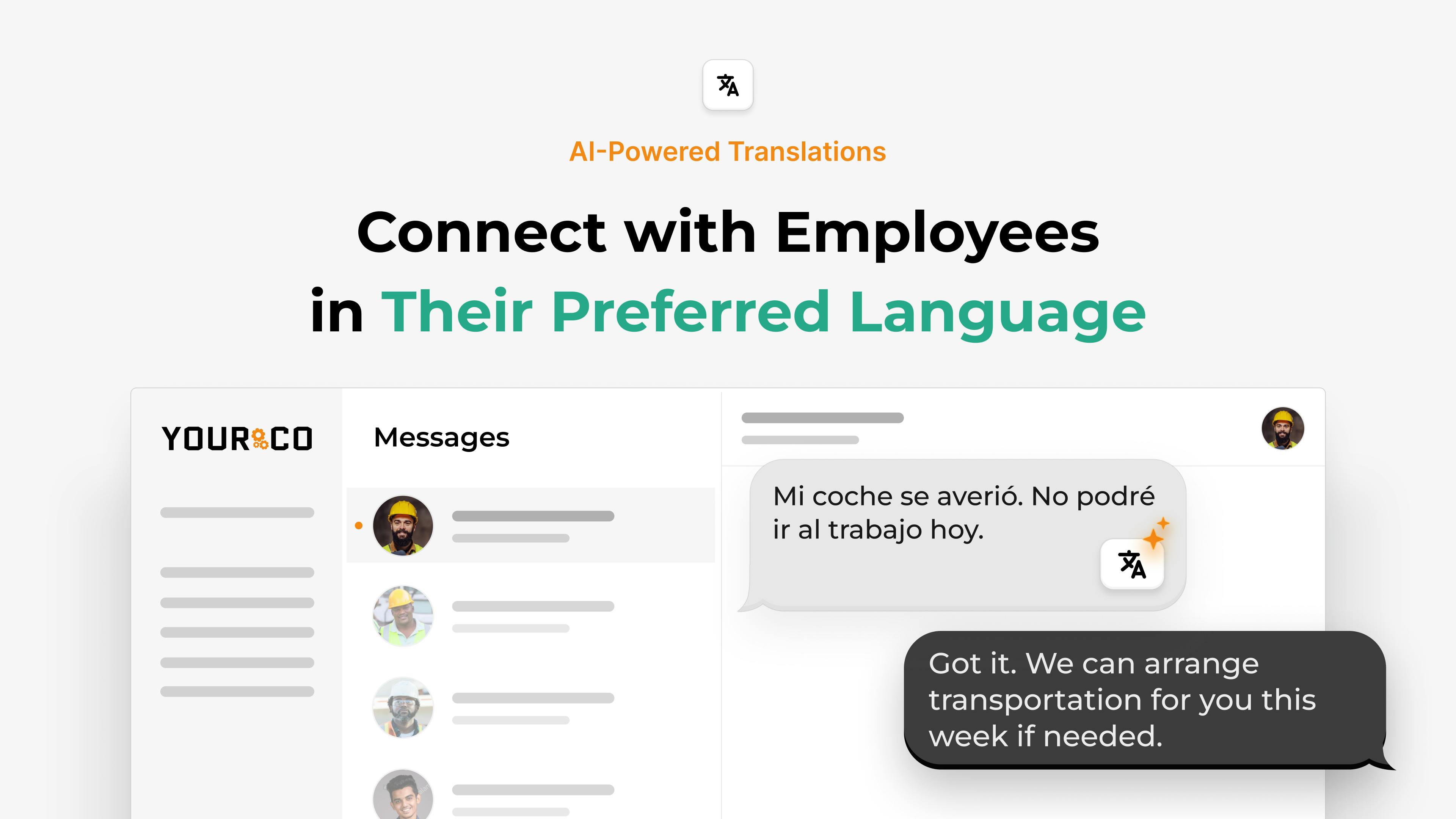
- AI-powered translation across 135+ languages and dialects, so language never filters out feedback
Yourco connects with 240+ HRIS and payroll systems, keeping employee data in sync as people join, exit, or change roles.
Enterprise Bridge enables one-way broadcasts from corporate leadership to the entire frontline workforce, keeping every location aligned on company-wide updates without requiring responses.
Frontline Intelligence gives HR and leadership teams centralized visibility into sentiment and retention-risk patterns by location and shift. It consolidates polls, surveys, and daily SMS interactions into a single view, surfaces disengagement signals as they emerge, and tracks sentiment trends across locations and shifts with AI translation applied, so feedback in any of 135+ languages reaches the dashboard. Leaders see delivery confirmation and response data, so they know what landed and what came back.
"We have nearly 700 employees and 80% are non-desk based, communication is a challenge. Yourco provides a quick easy way to reach everyone and a secure way for employees to reach HR and leadership without a computer."
— Felisha Parker, VP Human Resources, McCarthy Auto Group
After 90 days on Yourco, companies see two-way employee engagement reach 86%.
Try Yourco for free today, or schedule a demo to see the difference the right workplace communication solution can make for your company.
Frequently Asked Questions About Employee Voice Analytics
What is employee voice?
Employee voice is the ability of workers to express their views, opinions, concerns, and suggestions, and to have those ideas influence decisions at work. The word "voice" is metaphorical and refers to having a say through feedback or representation. It can be individual or collective, direct or through representatives.
What does employee sentiment analysis measure?
Employee sentiment analysis measures how employees feel about their work and why by applying NLP to written feedback such as survey comments and text replies. It identifies comment polarity and extracts the themes driving those feelings.
How is employee voice different from employee engagement?
Employee voice refers to what workers share and their ability to influence decisions. Engagement is a downstream outcome of feeling heard and connected to the work. When employees have a real voice and see action taken, they are more likely to feel engaged.
Why do traditional surveys miss frontline workers?
Traditional surveys miss frontline workers because most platforms assume a company email address, computer access during the workday, and enough uninterrupted time to respond. Many shift workers lack those conditions. Leaders should check access barriers before concluding that low participation means disengagement.
How can SMS-based platforms capture frontline employee voice?
SMS-based platforms like Yourco reach workers on the phone they already carry, with no app or login required. Workers respond to pulse surveys or raise concerns during a break, and AI analysis turns those text replies into sentiment and topic insight across multiple languages.