A single missed emergency alert can put workers at risk, and for organizations with frontline teams spread across manufacturing plants, logistics hubs, and construction sites, that risk multiplies when your notification system can't reach every shift, every location, or every language. Many organizations turn to platforms like AlertMedia for mass communication, but discover limitations when trying to reach frontline teams. From restricted survey capabilities to mobile app performance issues, these gaps become critical during actual emergencies. This article examines proven alternatives that solve the unique communication challenges of frontline workforces.
TL;DR
- AlertMedia provides multi-channel emergency notification but presents challenges for frontline workforces, including limited survey formats and mobile app performance issues.
- SMS-based alternatives like Yourco achieve 98% read rates within 90 seconds, work on any phone including basic flip phones, support AI-powered translation across 135+ languages and dialects, and integrate with 240+ HRIS systems.
- When evaluating alternatives, prioritize mobile-first communication, system integrations, transparent pricing, message delivery reliability, and compliance documentation capabilities.
Identify Critical Gaps in Your Current Emergency Notification System
AlertMedia provides multi-channel emergency notification across email, SMS, voice, and push notifications, making it a popular choice for many organizations. But companies with large frontline workforces consistently encounter specific limitations that drive them to evaluate alternatives.
The most significant barrier is AlertMedia's survey format. According to available documentation, AlertMedia surveys support yes/no questions along with follow-ups and free-text responses. This restriction prevents effective feedback collection for frontline operations requiring multi-option safety check-ins like "Safe / Minor Injury / Major Injury / Unable to Report" or shift availability surveys with multiple response categories.
Most organizations report that AlertMedia integrates well with their daily workflows, with only isolated comments about wanting even broader use. Modern frontline workforce management requires unified platforms handling both emergency and routine operational communications, from shift change notifications to safety protocol reminders.
Mobile app performance issues compound these challenges. According to comparative reviews, users report the mobile app performs slower than the web version, which is particularly problematic for frontline workers who rely entirely on mobile devices and need immediate access during emergencies.
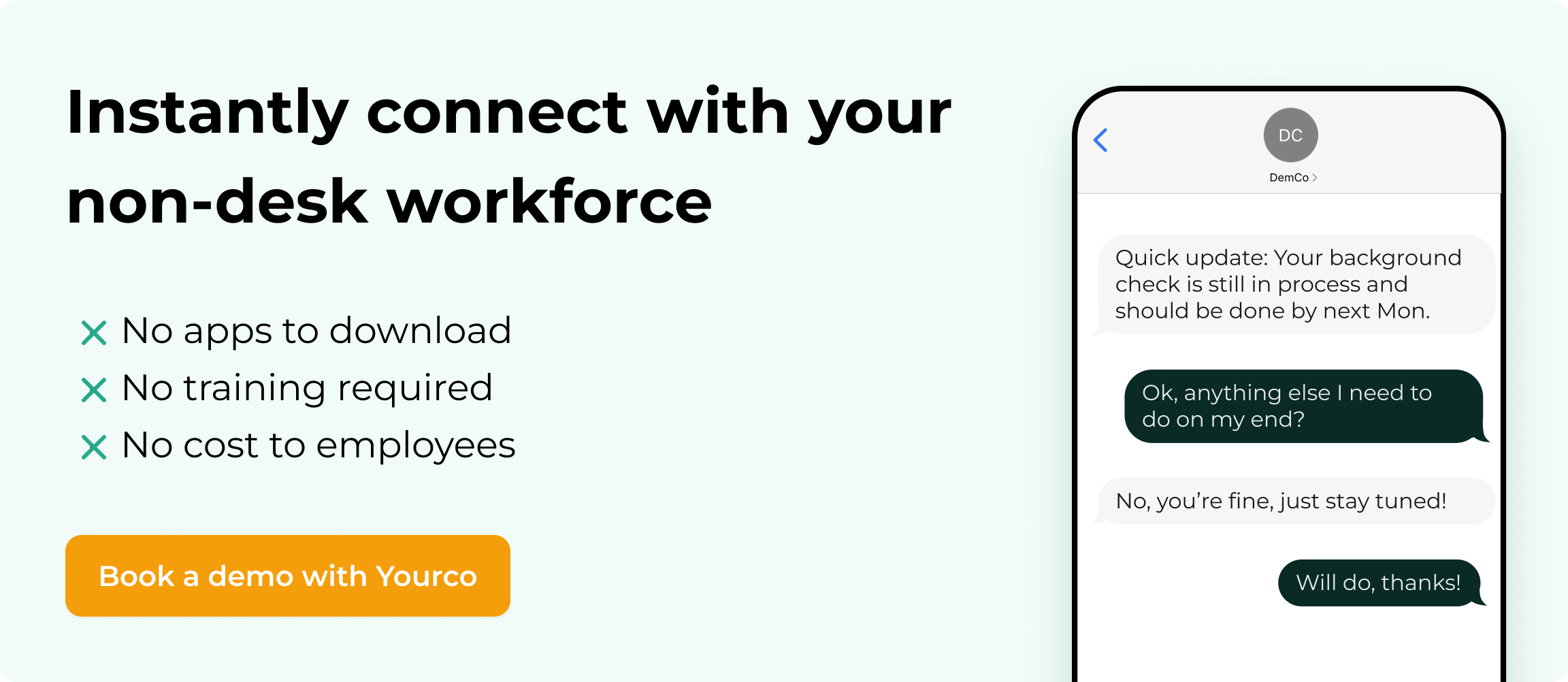
Yourco addresses these gaps by delivering emergency and operational messages through simple SMS text messaging with no app downloads, no performance issues, and no email access required. With 98% read rates typically achieved within 90 seconds, messages reach every worker on any mobile device, from smartphones to basic flip phones. The platform supports two-way communication with rich response options beyond yes/no, enabling detailed safety check-ins and workforce status confirmation during critical situations.
| Feature | AlertMedia | Yourco |
|---|---|---|
| Primary Channel | Multi-channel (Email, SMS, Voice, Push, Desktop) | Direct SMS: No app, data, or company email address required |
| HRIS Integration | Limited: Basic integration with limited capabilities | Advanced: 240+ HRIS integrations that sync all employee data in one place, eliminating manual data entry |
| Frontline Intelligence | Limited: Complicated dashboard that provides threat and incident trend reporting | Advanced: Yourco offers AI-powered insights based on the context of all your communication data.Ask workforce-related questions and uncover employee sentiment, behavior patterns, and potential safety concerns in real time. |
| Accessibility | Requires app download or email for full functionality | Universal: Works on any mobile device (smartphones to flip phones) |
| Engagement Rate | Varied based on channel and app adoption | High Performance: 86% increase in two-way communication and employee engagement after using Yourco |
| Device Performance | Mobile app often slower than web version; lag on older devices | Instant: Zero lag; leverages native device messaging |
| Routine Operations | Integrated daily workflows; primarily emergency focused | Unified: Designed for emergency, routine operational messaging and HR communications |
| Ideal for mixed desk/deskless environments | Frontline Optimized: Purpose-built for fronline workforce without company email |
Prioritize Mobile-First Communication for Your Frontline Team
Emergency notification platforms must function on the devices frontline workers actually carry and use throughout their shifts. Traditional systems designed for office workers often fail to reach non-desk employees who rarely access company email or may not have smartphones.
Federal testing reveals the critical importance of reliable message delivery. According to the Federal Communications Commission nationwide emergency alert test, nearly all Emergency Alert System participants successfully received test messages through the Wireless Emergency Alert system. Independent RAND Corporation analysis found that most cell phone users reported receiving the alert. These delivery rates far exceed app-based systems.
The adoption barrier for app-based platforms creates serious coverage gaps. Research from Natural Hazards Center at the University of Colorado Boulder documents that opt-in rates for emergency alert systems are often below 40%. Unlike SMS-based alerts that reach all capable devices by default, app-based systems require users to download applications and enable notifications.
Manufacturing floor workers, construction crews, logistics teams, transportation workers, and hospitality staff all need communication that reaches them instantly without requiring specific devices or apps. Effective alternatives prioritize SMS and text-based communication as the primary channel, not a backup option. Platforms offering mobile-first architecture specifically designed for non-desk workers receive consistently higher ease-of-use ratings than tools adapted from office-based environments.
Choose Platforms That Integrate With Your Existing Systems
Evaluate platforms based on their integration depth with your workforce management ecosystem. Everbridge explicitly documents integration capabilities with HRIS and business continuity systems, supporting employee roster data synchronization with organizational records. OnSolve offers API functionality and automated data sync capabilities. These integrations help maintain accurate contact information, ensuring that when you activate emergency notifications, they reach your current workforce rather than outdated employee lists.
Yourco's seamless integration with major HRIS platforms like ADP, Paychex, UKG, and Paylocity ensures employee contact information updates automatically without manual data entry. When employees join, transfer facilities, or update phone numbers in your payroll system, those changes sync to your communication platform immediately, eliminating the dangerous coverage gaps that occur when emergency contact lists fall out of date during periods of high frontline workforce turnover.
The importance of integration extends beyond emergency scenarios. For effective workplace communication, unified platforms that handle both emergency and operational communications provide significantly better ROI than single-purpose tools. When your emergency notification system integrates with scheduling platforms, you can send targeted shift-specific alerts, confirm availability for emergency overtime, and verify who's actually on-site during facility incidents.
Evaluate Total Cost Beyond Base Subscription Pricing
Pricing transparency varies dramatically across emergency notification platforms, creating significant challenges for budget planning and total cost of ownership analysis. While leading AlertMedia alternatives often require direct vendor contact for quotes, real contract data from sources like Vendr reveals substantial variation in actual costs.
The SMS Volume Risk
Beyond base fees, a critical budget risk is SMS volume surcharges. During severe weather or safety incidents, notification frequency spikes as updates are sent hourly to thousands of frontline workers. If a platform charges per message, these costs can quickly exceed budget expectations.
Yourco mitigates this risk by utilizing a predictable pricing structure based on employee count rather than usage. This ensures that even during a high-frequency emergency event, your costs remain fixed and manageable.
Calculating True ROI
When evaluating these platforms, look beyond simple cost-per-employee metrics. The true value lies in cost avoidance, which includes:
- Incident Prevention: Reducing the likelihood of workplace injuries.
- Response Speed: Minimizing downtime during safety events.
- Compliance: Mitigating legal and regulatory risk through documented communication.
When selecting an emergency notification platform, the final decision should rest on your workforce's specific environment and your need for financial predictability. While legacy systems offer extensive multi-channel features, their complexity and variable SMS costs can create both technical hurdles for frontline staff and unexpected budget spikes for leadership. By prioritizing a platform like Yourco that offers a simplified, SMS-native experience and a fixed-cost model based on headcount, you ensure that critical safety information is never delayed by app performance issues or restricted by message volume caps.
Ensure Message Delivery When It Matters Most
During actual emergencies like chemical spills, equipment failures, severe weather, or facility evacuations, your notification system must function precisely when traditional infrastructure may be failing. Marketing claims about "99.9% uptime" matter far less than verified performance under real-world crisis conditions.
System redundancy and failover capabilities determine whether your platform continues functioning during power outages, network disruptions, or infrastructure failures that often coincide with the emergencies you're trying to communicate about.
SMS-based emergency notification systems achieve superior message delivery in real-world testing. According to Federal Communications Commission testing, nearly all Emergency Alert System participants successfully received test messages through the Wireless Emergency Alert system, while independent RAND Corporation analysis found most cell phone users reported receiving alerts. For manufacturing, logistics, and construction companies with distributed frontline workforces, SMS-based platforms provide more reliable reach during critical incidents when workers need immediate safety information.
Real-time delivery confirmation and acknowledgment tracking enable operations managers to verify who received alerts and who requires direct follow-up during emergencies. This accountability proves important during incident response and worker safety verification. Platforms providing comprehensive delivery status dashboards, individual employee acknowledgment tracking, and automated escalation protocols for non-responders offer substantially more value than simple "message sent" confirmations.
Support Multiple Languages for Diverse Workforces
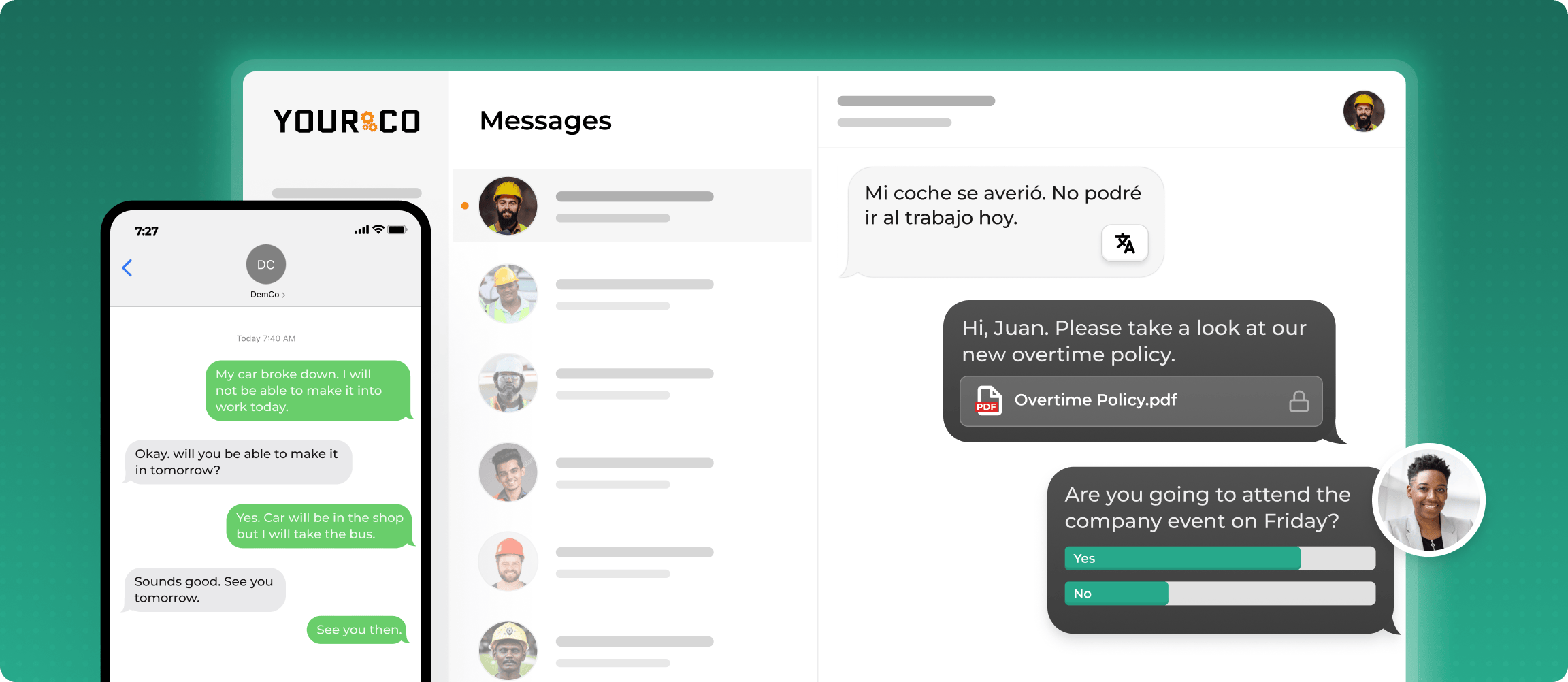
Yourco has the AI-translation feature that automatically translates employee messages to 135+ languages and dialects. Manufacturing plants, logistics operations, and construction sites employ diverse multilingual workforces where safety-critical information should reach all employees regardless of primary language. According to research on Safety 4.0 technologies, modern safety systems require integrated communication capabilities across language barriers to enable real-time hazard detection and worker alerting.
Pre-configured message templates in multiple languages represent one approach to this challenge. Organizations can prepare emergency notifications in advance for common scenarios like severe weather, facility evacuations, or equipment failures, ensuring translations are reviewed and approved before crises occur.
Real-time translation capabilities enable organizations to compose emergency messages once and automatically deliver them in each employee's preferred language. This approach combines speed with accessibility, ensuring that urgent custom messages reach multilingual workforces without translation delays.
The compliance dimension adds urgency to multilingual support. OSHA Standard 1910.38 describes emergency action plan requirements, including alarm systems capable of reaching all employees. For organizations employing workers who don't fluently speak English, meeting this regulatory goal often means those workers should be able to comprehend emergency action plans and safety alerts.
This information is for general awareness only. For specific compliance guidance, consult with qualified legal professionals.
Verify Compliance and Audit Trail Capabilities
Documentation of emergency communications protects organizations during OSHA inspections, incident investigations, and legal proceedings while supporting regulatory compliance across multiple jurisdictions.
Your documentation should include several critical elements: who sent messages and when alerts were issued, what content was transmitted to employees, which employees received notifications and delivery confirmations, how workers responded and acknowledgement records, and all communication timestamps for regulatory verification.
These detailed logs form the foundation of compliance documentation. Exportable reports formatted for regulatory submissions enable HR and safety teams to provide required documentation during OSHA inspections without manual data compilation.
Long-term data retention requirements vary by industry and jurisdiction, with retention periods typically spanning 5-7 years or longer. Platforms with tamper-proof archival systems meeting evidentiary standards provide greater protection during legal proceedings and compliance audits.
Data security and privacy controls protect both organizations and employees. SOC 2 Type II or equivalent third-party security certifications, encryption in transit and at rest, GDPR compliance, and role-based access controls represent baseline security requirements for enterprise emergency notification systems.
Reach Your Entire Workforce With Yourco
Emergency notification systems should solve real-world frontline communication challenges: reaching workers without email access, delivering messages in multiple languages, integrating with existing workforce systems, and providing verifiable delivery during actual crisis situations.
Yourco reduces the complexity and adoption barriers of traditional emergency notification platforms by leveraging a communication channel that reaches most frontline workers: text messaging. Built specifically for frontline workforces in manufacturing, logistics, construction, transportation, and hospitality, Yourco delivers emergency alerts and operational communications via SMS to any mobile device. No app downloads, email accounts, or smartphones required. Messages work on basic flip phones just as effectively as the latest smartphones, ensuring message delivery that typically achieves 98% read rates within 90 seconds without creating a two-tiered communication system that leaves some workers disconnected.
The platform's AI-powered automatic translation across 135+ languages and dialects means you compose emergency alerts once and workers receive them instantly in their preferred language. Integration with major HRIS and payroll systems keeps employee contact information current without manual updates, eliminating dangerous data gaps during time-sensitive situations. Comprehensive delivery tracking, acknowledgment confirmation, and compliance documentation provide the audit trails regulatory requirements demand while giving operations managers real-time visibility into who received critical safety alerts and who needs direct follow-up.
Core Features of Yourco for Frontline Teams
- App-Free SMS Communication: Reaches workers on any mobile device—from the latest smartphones to basic flip phones—without requiring app downloads, data plans, or company email accounts.
- AI-Powered Automatic Translation: Instantly translates alerts into over 135 languages and dialects based on employee preference, allowing you to send one message that every worker understands.
- High-Speed Engagement: Typically achieves a 98% read rate within 90 seconds, ensuring critical safety information is seen faster than via email or app-based push notifications.
- Seamless HRIS & Payroll Integration: Connects with over 240+ platforms to automatically sync employee contact data, eliminating manual updates and dangerous information gaps.
- Two-Way Interaction: Enables frontline workers to reply to alerts, allowing for real-time safety check-ins, shift confirmations, and direct feedback from the floor.
- Comprehensive Compliance Tracking: Provides verifiable delivery logs, timestamped acknowledgments, and searchable archives for regulatory audits and post-incident analysis.
- Targeted Messaging: Segments alerts by location, shift, department, or role to ensure relevant information reaches the right people without causing "message fatigue."
When selecting an emergency notification platform, the final decision should rest on your workforce's specific environment and your need for financial predictability. While legacy systems offer extensive multi-channel features, their complexity and variable SMS costs can create both technical hurdles for frontline staff and unexpected budget spikes for leadership.
By prioritizing a platform like Yourco that offers a simplified, SMS-native experience and a fixed-cost model based on headcount, you ensure that critical safety information is never delayed by app performance issues or restricted by message volume caps.
Try Yourco for free today or schedule a demo and see the difference the right workplace communication solution can make in your company.
Frequently Asked Questions
What's the biggest difference between SMS-based and app-based emergency notification systems?
SMS-based systems can reach most mobile devices capable of receiving text messages without requiring app downloads, though typical deployments do require prior phone number collection and consent. App-based platforms typically struggle with adoption because workers must download applications and enable notifications. For frontline workforces where not everyone has smartphones or company-issued devices, SMS provides dramatically better reach during actual emergencies.
How much should we expect to pay for emergency notification platforms?
Pricing varies significantly depending on platform and deployment scale. Mid-market solutions include Regroup starting at $500 per month. Enterprise platforms like Everbridge serve larger organizations with more complex needs. Request transparent pricing including SMS volume charges, which can increase during actual emergencies when notification frequency spikes. In contrast, SMS-based platforms like Yourco offer more transparent and predictable pricing by charging based on employee headcount rather than feature tiers, $3 per employee per month.
How do we handle multiple languages across our frontline workforce?
Look for platforms offering either pre-configured message templates in multiple languages or real-time automatic translation. Pre-configured templates work well for anticipated scenarios like severe weather or facility evacuations. Real-time translation provides flexibility for unique emergencies requiring custom messages. The best solutions automatically deliver messages in each employee's preferred language based on HRIS data without requiring manual translation management.